FAQ – GST change 2023
The amount relating to the option money paid before 1 Jan 2023 is subject to the GST rate of 7%.
The remaining payment will be subject to the GST rate of 8% as the property is only made available on/ after 1 Jan 2023.
If you receive full payment for the banquet before 1 Jan 2023, you should only charge 7% GST to your customer even if the banquet is to be held on/ after 1 Jan 2023.
If you only receive a deposit before 1 Jan 2023 and will receive the balance on/ after 1 Jan 2023, the deposit is subject to 7% GST while the remaining payment is subject to 8% GST.
You should also make clear to your customer that the portion of the banquet price paid before 1 Jan 2023 is inclusive of 7% GST while the balance to be paid on/ after 1 Jan 2023 is inclusive of 8% GST.
The letter of claim is not a bill for payment (i.e. invoice) for GST purposes.
On the understanding that you would only issue the invoice to the developer upon the certification of the work done in 2023 and collect payment from the developer thereafter, the time of supply would be on/ after 1 Jan 2023. Hence, the supply of your construction services would be subject to 8% GST.
However, you can choose to charge GST at 7% as you have completed the construction works before 1 Jan 2023.
As you would only issue the invoice and collect the retention sum from the developer in Nov 2023, the time of supply would be on/ after 1 Jan 2023. Hence, the retention sum would be subject to 8% GST.
However, you can choose to charge GST at 7% on the retention sum as you have completed the construction works before 1 Jan 2023.
You are not allowed to reflect GST at 8% before the rate change effective date of 1 Jan 2023.
The advance invoice pertaining to the services from 1 Oct 2022 to 31 Mar 2023 should reflect GST at 7%.
If you do not receive full payment before 1 Jan 2023, you are required to issue a credit note for the lower of remaining payment or the remaining value of service to be performed on/ after 1 Jan 2023. Thereafter, you are required to issue a new tax invoice in respect of the amount credited out to charge GST at 8%.
Alternatively, you may issue a credit note to cancel out the original invoice and at the same time, reissue new tax invoice(s) for the value of supply subject to GST at 7% and value of supply subject to GST at 8% .
No. You are not allowed to issue a tax invoice with GST at 8% before the rate change effective date.
If you issue a tax invoice before 1 Jan 2023, you should reflect 7% GST on the tax invoice. If the payment is not received before 1 Jan 2023, you will need to issue credit note to cancel the original tax invoice and to issue a new tax invoice for the goods delivered after the rate change, showing 8% as the GST rate.
When you issue the tax invoice to your customer before 1 Jan 2023, you are advised to inform your customer on the potential GST adjustment under the rate change transitional rules to avoid dispute on the GST rate and GST amount payable on the supply.
You are not allowed to reflect GST at 8% before the rate change effective date of 1 Jan 2023. Hence, your invoice that is issued in Dec 2022 should reflect GST of 7% on the rental for the period 5 Dec 2022 to 4 Jan 2023.
Subsequently, assuming payment has not been received before 1 Jan 2023, you should issue a credit note by 15 Jan 2023 to cancel the portion of the rental for the period 1 Jan 2023 to 4 Jan 2023 billed at 7%, and to issue a new tax invoice at 8% for the same period.
The rental can be apportioned based on the number of days as follows:
Portion of rental that is subject to the GST of 7%
= Monthly rental x 27/ 31 days
Portion of rental that is subject to the GST of 8%
= Monthly rental x 4/ 31 days
When you issue the tax invoice to your customer before 1 Jan 2023, you are advised to inform your customers on the potential GST adjustment under the rate change transitional rules to avoid dispute on the GST rate and GST amount payable on the supply.
If you provide rebates to your customer that represent a discount for a past sale, you should calculate the GST on the rebate using the rate that is originally charged on the sale.
On the other hand, if the rebate is used to offset against the value of your next sale to your customer which takes place on or after 1 Jan 2023, you should charge GST at 8% on the net value of the sale.
For returned goods, you should adjust the GST using the rate that is originally charged on your supply of goods and maintain documentary evidence to show whether the goods returned were supplied before or on/after 1 Jan 2023.
Source: IRAS – FAQ
Changes to Singapore GST in 2023
In Budget 2022, the Minister for Finance announced that the GST rate will be increased from:
(i) 7% to 8% with effect from 1 Jan 2023; and
(ii) 8% to 9% with effect from 1 Jan 2024.
The revenue from the increase in GST will go towards supporting our healthcare expenditure, and to take care of our seniors
Rules for Supplies that span the change of GST rate
A supply spans the change of GST rate where one or two of the following events takes place wholly or partially on or after 1 Jan 2023:
- the issuance of invoice;
- the receipt of payment (or the making of payment in respect of a reverse charge supply);
- the delivery of goods or performance of services.
Invoice issued on or after 1 Jan 2023
Full payment received before 1 Jan 2023 Goods delivered after 1 Jan 2023
If you issue an invoice for your supply on or after 1 Jan 2023 but you receive full payment before 1 Jan 2023, the supply is subject to 7% GST.
Full payment received after 1 Jan 2023 Goods delivered before 1 Jan 2023
If you issue an invoice for your supply on or after 1 Jan 2023 but you have delivered all the goods or performed all the services before 1 Jan 2023, the entire value of the supply is subject to 7% GST.
Invoice is issued before 1 Jan 2023
Full payment received or Goods delivered before 1 Jan 2023
If you have received full payment before 1 Jan 2023, or if you have delivered all the goods or performed all the services before 1 Jan 2023, the entire value of the supply is subject to 7% GST.
Partial payment received or partial goods delivered before 1 Jan 2023
If you do not receive full payment before 1 Jan 2023 and you have delivered or performed a part or all of the goods or services before 1 Jan 2023, you can elect to charge 7% GST on the higher of:
(a) The payment received is before 1 Jan 2023; or
(b) The value of goods delivered or services performed is before 1 Jan 2023.
The remaining value of the supply will be subjected to 8% GST.
Supply involving invoice issued before 1 Jan 2023 – full payment received after 1 Jan 2023
On 22 Dec 2022, you issue a tax invoice for your supply of services (value of $1,000) and you receive the full payment on 5 Jan 2023. You perform part of the services (value of $200) before 1 Jan 2023 and the remaining part of the services (value of $800) after 1 Jan 2023.
You must charge and account for GST at 7% ($70) for the tax invoice issued to your customer on 22 Dec 2022. As you do not receive any payment and only perform part of the services before 1 Jan 2023, under the transitional rules, you are required to issue the following to your customer by 15 Jan 2023, for that part of the services performed after 1 Jan 2023:
- a credit note for $856 ($800 plus 7% GST of $56); and
- a new tax invoice for $864 ($800 plus 8% GST of $64).
Supply involving invoice issued before 1 Jan 2023 – payments straddle 1 Jan 2023
On 21 Dec 2022, you issue a tax invoice for your supply of services (value of $1,000). Before 1 Jan 2023, you delivered part of the goods (value of $400) and received a payment of $200. After 1 Jan 2023, you receive the remaining payment of $800 and perform delivered the other part of the goods (value of $600).
Under the transitional rules, you are required to issue the following by 15 Jan 2023, for that part of the goods delivered after 1 Jan 2023:
- a credit note for $642 ($600 plus 7% GST of $42); and
- a new tax invoice for $648 ($600 plus 8% GST of $48)
Budget 2022: Support for Businesses
Jobs and Business Support Package
Jobs Growth Incentive
Jobs Growth Incentive provides salary support for employers to expand local hiring from September 2020 to March 2022 (inclusive). Jobs Growth Incentive has been extended by six months to September 2022, with stepped-down rates reflecting the improved labour market conditions. This extension will only cover mature workers aged 40 and above who have not been employed for six months or more, persons with disabilities, and ex-offenders.
Employers that increase their overall local workforce between September 2020 and September 2022 (inclusive) will receive Government support as follows:
- Phase 1 of the JGI: September 2020 to February 2021
- For non-mature local worker – Up to 25% of first $5,000 for 12 months
- For mature, PwD or ex-offender local hires – For gross monthly wages paid in Sep 2020 – Feb 2021, up to 50% of first $5,000
- For mature, PwD or ex-offender local hires – For gross monthly wages paid from Mar 2021 onwards, up to 50% of first $6,000 for 18 months
- Phase 2 of the JGI: March 2021 to September 2021
- For non-mature local worker – Up to 25% of first $5,000 for 12 months
- For mature, PwD or ex-offender local hires – Up to 50% of first $6,000 for 18 months
- Phase 3 of the JGI: October 2021 to March 2022
- For non-mature local worker – Up to 15% of first $5,000 for 6 months
- For mature, PwD or ex-offender local hires – Up to 50% of first $6,000 for 12 months
- Phase 4 of the JGI: April 2022 to September 2022
- For mature, PwD or ex-offender local hires – Details to be announced.
Employers do NOT need to apply for the JGI. IRAS will notify eligible employers by post of the amount of JGI payout payable to them. They can also log in to myTax Portal to view the electronic copy of their letter.
Small Business Recover Grant
Small Business Recover Grant provides a one-off cash support to small business in sectors that were most affected by Covid-19 Safe Management Measures last year.
Eligibility:
Business is physically present in Singapore and registered no later than 31 December 2021.
Annual operating revenue is less than S$100 million, filed with IRAS in the YA 21 by 31 December 2021; or employ fewer than 200 employees as of 31 December 2021.
Eligible firm will receive:
$1,000 payout per local employee with mandatory CPF contribution. (Capped at S$10,000 per firm);or
$1,000 payout to local sole proprietors and partnerships without hire any local employees and earning a net trade income of no more than S$100,000.
Employers do NOT need to apply. IRAS will notify eligible firms starting from June 2022.
Enhanced Financing Support
Temporary Bridging Loan Programme (TBLP)
The Temporary Bridging Loan Programme (TBLP) provide enterprises with access to working capital during the COVID-19 crisis. The TBLP will be extended for another six months to 30 September 2022, with revised parameters, in view of the continued impact of COVID-19 and recent increase in business costs.
Eligibility:
- Be a business entity that is registered and physically present in Singapore
- At least 30% local equity held directly or indirectly by Singaporean(s) and/or Singapore PR(s), determined by the ultimate individual ownership
Application:
Enterprise Financing Scheme – Trade Loan (EFS-TL)
The Enterprise Financing Scheme – Trade Loan (EFS-TL) supports Singapore-based enterprises’ trade financing needs, which include the financing of short-term import, export, and guarantee needs. The enhancement to EFS-TL will be extended for a further six months to 30 September 2022, with revised parameters given continued uncertainties in the global trade ecosystem.
Finance trade needs, including:
- Inventory / stock financing
- Structured pre-delivery working capital (revolving working capital)
- Factoring (with recourse) / bill of invoice / AR discounting
- Overseas working capital loan
- Bank Guarantee (capped at 2 years tenure)
Eligibility:
- Be a business entity that is registered and physically present in Singapore, and
- At least 30% local equity held directly or indirectly by Singaporean(s) and/or Singapore PR(s), determined by the ultimate individual ownership, and
- Have Group Annual Sales Turnover of not more than S$500 million
Enterprise Financing Scheme – Project Loan (EFS-PL)
The Enterprise Financing Scheme – Project Loan (EFS-PL) supports Singapore-based enterprises’ overseas project financing needs, which include the financing of working capital, guarantee, and fixed assets. The enhancement to EFS-PL will be extended for another year to 31 March 2023, to support
construction enterprises in fulfilling domestic projects amidst rising costs and tightened cashflow.
Finance the fulfillment of secured overseas projects. The supportable loan types include:
- Working Capital Loan
- Factory/ Building/ Land (includes Purchase/ Renovation/ Construction)
- Equipment/ Machineries/ Vessels/ Other Fixed Assets/ Machinery Hire Purchase
- Guarantees
Enterprise Financing Scheme – Merger and Acquisition Loan (EFS-M&A)
The Enterprise Financing Scheme – Merger and Acquisition Loan (EFS-M&A) supports Singapore-based enterprises’ acquisition of overseas or local enterprises, with the intent of internationalisation. The EFS-M&A will be enhanced for four years, from 1 April 2022 to 31 March 2026, to include domestic M&A activities. This is to support enterprises to scale and expand through M&A, including venturing into complementary businesses and emerging sectors.
Investing in Digital Capabilities
Advanced Digital Solutions (ADS)
ADS promote and amplify the adoption of advanced integrated solutions. To increase firms’ competitive advantage and drive business growth, the Government will be extending support for adoption of cutting-edge digital solutions through the Infocomm Media Development Authority (IMDA)’s Advanced Digital Solutions (ADS) initiative.
From 1 April 2022, the scheme will be expanded to include solutions that leverage Artificial Intelligence (AI) and Cloud technologies, to help enterprises improve operational efficiency and business decisions. Participating enterprises will receive up to 70% funding support for these solutions.
Any business entity that meets the following requirements will be eligible:
- Registered and operating in Singapore;
- Minimum of 30% local shareholding; and
- Group sales turnover less than S$100 million per annum, or group employment less than 200 employees
Enterprises can contact the project leads of the ADS projects they are interested in.
Grow Digital scheme
The Government will also be expanding the Grow Digital scheme, to help businesses better leverage digital platforms to reach international markets.
From 1 April 2022, Grow Digital will be expanded to include more pre-approved digital platforms, so that more businesses can internationalise without requiring an in-market presence. Participating enterprises will receive up to 70% funding support to onboard the B2B and B2C platforms.
Eligibility:
- Business entity registered and operating in Singapore;
- Minimum of 30% local shareholding; and
- Group annual turnover less than S$100 million per annum, or group employment less than 200 employees.
If you are interested to participate as a Grow Digital Partner, please write to SMEs_Go_Digital@imda.gov.sg.
TechSkills Accelerator (TeSA)
The TechSkills Accelerator (TeSA) initiative aims to develop a skilled Information and Communication Technology (ICT) workforce for Singapore’s digital economy, in collaboration with industry partners and the National Trades Union Congress (NTUC). In the coming year, TeSA will expand on several fronts to build a strong Singaporean core of ICT talent. These include:
(i) partnering with industry leaders to grow product development teams in Singapore;
(ii) expanding TeSA to SMEs and startups to provide more job opportunities for mid-career workers; and
(iii) upskilling our current digital workforce to keep their skills relevant.
Encouraging Enterprise and Workforce Transformation
SkillsFuture Enterprise Credit (SFEC)
The SkillsFuture Enterprise Credit (SFEC) encourages employers to undertake enterprise and
workforce transformation initiatives. Eligible employers receive a one-off credit of up to $10,000 to cover up to 90% of out-of-pocket expenses for supportable enterprise transformation programmes and workforce transformation programmes of the $10,000 credit for an eligible employer, $3,000 is ringfenced for workforce transformation initiatives.
The SFEC eligibility criteria have been adjusted in Budget 2022 to expand the coverage of SFEC for the qualifying period from 1 January 2021 to 31 December 2021:
- [New] No minimum Skills Development Levy (SDL) contribution requirement over the qualifying period. However, employers with inactive ACRA status during the qualification process and employers who have defaulted on their SDL payment during the qualifying period will be excluded.
- [No change] Employment of at least three Singapore Citizens or Permanent Residents every month over the qualifying period.
- [No change] Did not qualify in any of the earlier periods.
Tax System
Extend and enhance the Approved Royalties Incentive (ARI)
The ARI was introduced to encourage companies to access cutting-edge technology and know-how for substantive activities in Singapore.
To continue encouraging companies to leverage new technologies and know-how to develop the
capabilities of our local workforce and capture new growth opportunities, the ARI will be extended till 31 December 2028. The ARI will also be simplified to cover classes of royalty agreements based on an activity-set-based approach.
Extend the Approved Foreign Loan (AFL) scheme
The AFL scheme was introduced to encourage companies to invest in productive equipment for the purpose of conducting substantive activities in Singapore. Under the scheme, tax exemption or a concessionary WHT rate may be granted on interest payments made to a non-tax resident for loans to a company to purchase productive equipment.
To continue encouraging companies to invest in productive equipment for the purpose of conducting substantive activities in Singapore, the AFL scheme will be extended till 31 December 2028.
Extend the Tax Framework for Facilitating Corporate Amalgamations under section 34C of the ITA to Licensed Insurer
The tax framework under section 34C of the ITA treats qualifying corporate amalgamations as a continuation of the existing businesses of the amalgamating companies by the amalgamated company for tax purposes. The tax framework minimises the tax consequences arising from a qualifying corporate amalgamation.
To ensure parity in treatment for all companies, including those that are in the insurance business, the tax framework for facilitating corporate amalgamations will be extended to cover amalgamation of Singapore-incorporated companies involving a scheme of transfer under section 117 of the Insurance Act 1966 (IA), where the court order for the confirmation of the scheme referred to under section 118 of the IA is made on or after 1 November 2021.
The extension of the framework is subject conditions, which include the following:
- The amalgamated company takes over all property, rights, privileges, liabilities, and obligations, etc. of the amalgamating company on the date of amalgamation; and
- The amalgamating company becomes dormant (i.e. ceases to conduct any business or any other activities, and does not derive any income) on the date of amalgamation and remains so until it is dissolved or wound up; and
- The amalgamating company is dissolved or wound up before the filing due date of the income tax return for the Year of Assessment (“YA”) related to the basis period in which the scheme of transfer was effected.
Update the GST treatment for travel arranging services
Currently, the GST treatment of the following travel arranging services provided by local suppliers is as follows:
- Services comprising the arranging of international transport of passengers and the arranging of insurance related to such transportation are zero-rated; and
- Services comprising the arranging of accommodation are standard-rated if the property is located in Singapore, and zero-rated if the property is located outside Singapore.
To ensure that our GST system remains resilient in a growing digital economy, the basis for determining whether zero-rating applies to a supply of travel arranging services will be updated, to be based on the place where the customer (i.e. the contractual customer) and direct beneficiary of
the service belong:
- If the customer of the service belongs in Singapore, the travel arranging service will be standard-rated; or
- If the customer of the service belongs outside Singapore and the direct beneficiary either belongs outside Singapore or is GST-registered in Singapore, the travel arranging service will be zero-rated.
This change will ensure that the GST rules accurately reflect the place of consumption of travel arranging services. The change will also ensure parity in GST treatment between local and overseas suppliers on the supplies of travel arranging services. This change will take effect from 1 January 2023.
Integrated Investment Allowance (IIA) scheme to lapse after 31 December 2022
The IIA scheme grants a qualifying company an additional allowance on fixed capital expenditure incurred for qualifying productive equipment placed overseas for approved projects.
The IIA scheme is scheduled to lapse after 31 December 2022.
Increase the GST rate
The GST rate has been 7% since 1 July 2007. To meet increased recurrent spending needs, the GST rate will be increased in two steps:
- From 7% to 8% with effect from 1 January 2023; and
- From 8% to 9% with effect from1 January 2024.
Measures To Support Charities
Extension of Tote Board’s Enhanced Fund-Raising Programme (EFR)
Top-up to the Charities Capability Fund (CCF)
Extension of the One Team Singapore Fund (OTSF)
Top-up to the Cultural Matching Fund (CMF)
The CMF aims to encourage broad-based cultural philanthropy through the provision of dollar-for-dollar matching for private cash donations to eligible arts and heritage charities. To encourage continued giving to the arts and heritage sector, the Government will provide a $150 million top-up to the CMF and extend the scheme for three years, from FY2022 to FY2024.
Foreign Workforce Policies
Employment Pass (EP)
The Government will ensure that EP holders are comparable in quality to the top one-third of our local Professionals, Managers, Executives, and Technicians (PMET) workforce. Therefore, the EP minimum qualifying salary will be raised from $4,500 to $5,000. The Financial Services sector will continue to have a higher EP minimum qualifying salary, which will be raised from $5,000 to $5,500.
These changes will apply to new EP applications from 1 September 2022, and to renewal applications from 1 September 2023.
S Pass
The Government will ensure that S Pass holders are comparable in quality to the top one-third of our local Associate Professionals and Technicians (APT) workforce. Therefore, the S Pass minimum qualifying salary will be raised in phases, with the first step on 1 September 2022 for new applications, and subsequently on 1 September 2023 and 1 September 2025. A higher S Pass qualifying salary for the Financial Services sector will also be introduced on 1 September 2022 for new applications.
These changes will apply to renewal applications one year later (e.g. the increase for new applications from 1 September 2022 will only affect renewals from 1 September 2023 onwards).
Foreign Worker Levy (FWL) Rates
The Tier 1 S Pass FWL rate will be progressively raised from $330 to $650 by 2025
Work Permit Holders in Construction and Process Sectors
From 1 January 2024, the FWL rates for Work Permit holders (WPHs) in the Construction and
Process sectors will be adjusted. The Man-Year Entitlement (MYE) framework in both sectors will also be dismantled.
Dependency Ratio Ceiling (DRC)
The DRC will be reduced for the Construction and Process sectors from 1 January 2024.
Uplifting Lower-Wage Workers
Progressive Wage Credit Scheme
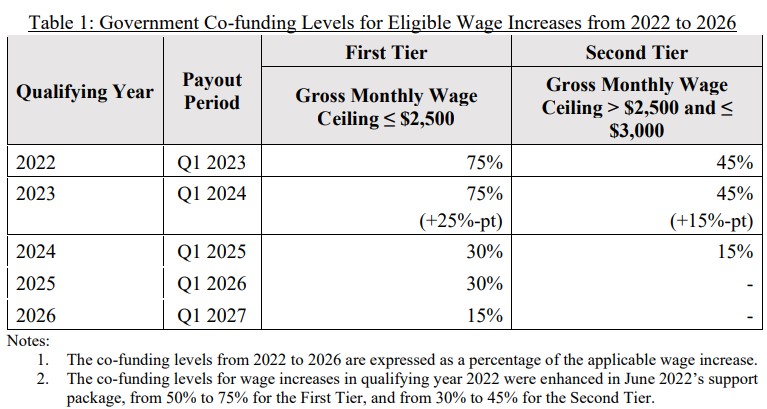
PWCS provides transitional support to employers by co-funding wage increases of lower-age workers between 2022 and 2026. Employers do not need to apply. The Inland Revenue Authority of Singapore (IRAS) will credit payouts for employers that have implemented eligible wage increases into their accounts by the first quarter of the year following the wage increases.
The PWCS has the following features:
-
Targeted at resident lower-wage employees with gross monthly wages of up to $2,500. This support will be provided from 2022 to 2026. The qualifying wage ceiling of $2,500 is aligned to that for the enhanced Workfare Income Supplement scheme.
-
Additional tier of support for employees with gross monthly wages above $2,500 and up to $3,000. In view of the uncertain economic conditions in the immediate term, the Government will provide some support for the wage increases of employees earning above $2,500 and up to $3,000 who marginally miss the first wage tier. This additional support will be provided from 2022 to 2024.
-
Average gross monthly wage increase must be at least $100 to be eligible for the PWCS payout in each qualifying year.
-
Co-fund wage increases in each qualifying year for two years. For example, a 2022 wage increase will be supported in qualifying year 2022, and also in 2023 if sustained. The approach helps employers manage the compounding effect of wage increases year on year.
Workfare Income Supplement Scheme
The Government will enhance the Workfare Income Supplement scheme to supplement the
incomes and CPF savings of lower-wage Singaporean workers, and encourage them to work regularly. Workfare is paid directly to eligible workers. These changes will apply to work done from 1 January 2023.
Changes to Workfare Income Supplement Scheme
- Qualifying monthly income cap raised from $2,300 to $2,500.
- Extension of Workfare to those aged 30-34.
- Higher annual Workfare payouts of up to $4,200. Payouts depend on age and income, and have been enhanced across all age bands. Eligible employees can receive up to $4,200 per year in payouts, compared to $4,000 per year today. Older workers will continue to receive the highest payouts. The payouts for self-employed persons are set at two-thirds of employee payouts and will be correspondingly increased.
- All persons with disabilities will qualify for the highest Workfare payout tier (up
to $4,200), regardless of age. - Minimum qualifying monthly income criterion of $500.
Notes:
[1] As PWCS is effective from 2022, wage increases in 2021 (i.e. increases in 2021 from the 2020 wage) will not be supported by PWCS.
[2] Calculation of total PWCS payout in the year assumes that employer makes 12 months of CPF contributions for each qualifying year.
Employee who earned $4,000 per month in 2021, and experiences average gross monthly wage increase of $100 in January of each year
PWCS will not co-fund the wage increases of this employee, as the employee is earning above the wage threshold of $3,000
Senior Worker CPF Contribution Rate And CPF Transition Offset
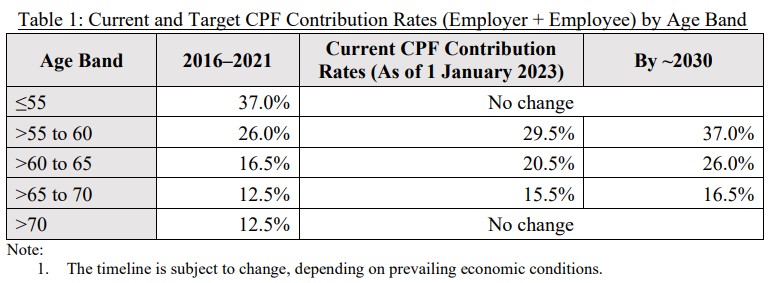
The Government announced that CPF contribution rates will be raised gradually over this decade for Singaporean and Permanent Resident workers aged above 55 to 70
When the increases have been fully implemented, those aged above 55 to 60 will have the same CPF contribution rates as younger employees, and the median 55-year-old member can expect his monthly retirement payouts to be boosted by close to 10% compared to under today’s rates.
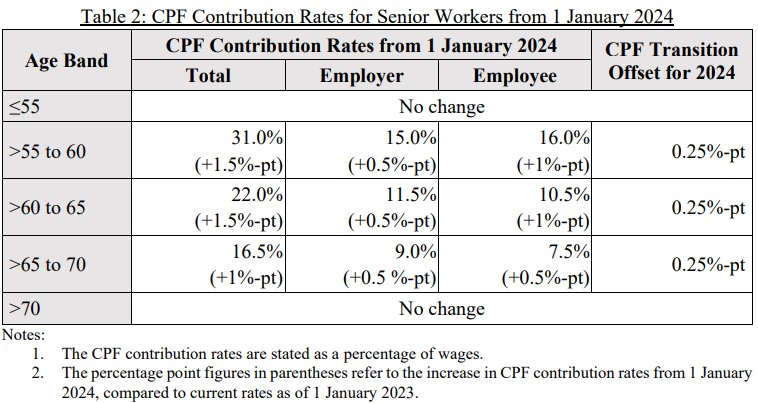
The first increase took effect from 1 January 2022. To mitigate the rise in business costs due to the increase of CPF contribution rates in 2022, the Government is providing employers with a one-year CPF Transition Offset equivalent to half of the increase in employer CPF contribution rates for every Singaporean and Permanent Resident worker they employ who is aged above 55 to 70.
The next increase in senior worker CPF contribution rates will take place on 1 January 2023. A similar one-year CPF Transition Offset will be automatically provided for the 2023 increases; employers need not apply.
Enhanced JSS Support from 25 Oct to 21 Nov 2021
From 25 October to 21 November 2021 onwards, the Government will provide enhanced JSS support for the following sectors:
The enhanced payout corresponding to wages paid for Aug to Oct 2021 will be disbursed in December 2021. Employers who put local employees on mandatory no-pay leave (NPL) or retrench them will not be entitled to the enhanced JSS payouts for those employees.
If your company has an existing GIRO arrangement with IRAS or is registered for PayNow Corporate as at 24 Sep 2021, you will receive a payout titled “Jobs Support Scheme” (GIRO) or “GOVT” (PayNow Corporate) in your bank account from 30 Sep 2021. Other employers will receive their cheques from 15 Oct 2021 mailed to their registered business address.
As part of the checks for JSS eligibility, a small number of employers will receive letters from IRAS asking them to conduct a self-review of their CPF contributions and to provide declarations or documents to substantiate their eligibility for JSS payouts. Their Sep 2021 payout will be withheld pending the self-review and verifications by IRAS. The payout will only be disbursed after the completion of the review. If your company has been selected for self-review, please refer to Self-review for Eligibility of JSS and JGI for more information.
Refresh Progressive Wage Approach and Coverage
What is the Progressive Wage Model?
Developed by tripartite committees consisting of unions, employers and the government, the PWM helps to uplift low-wage workers in the cleaning, security and landscape sectors.
Wages in these sectors had stagnated due to widespread cheap sourcing. The low wages in turn resulted in high turnover and labour shortages.
The PWM benefits workers by mapping out a clear career pathway for their wages to rise along with training and improvements in productivity and standards.
At the same time, higher productivity improves business profits for employers. Service buyers also enjoy better service standards and quality.
What is the Local Qualifying Salary (LQS)?
The Local Qualifying Salary is used to determine the number of local employees that count towards a company’s foreign worker ratio.
This ensures that local workers are employed meaningfully, rather than being employed on token salaries to allow the employer access to foreign workers.
A Singaporean or Permanent Resident employee employed under a contract of service, including the company’s director, is counted as:
- 1 local employee if they earn the LQS of at least $1,400 per month.
- 0.5 local employee if they earn half the LQS of at least $700 to below $1,400 per month.
Refresh Progressive Wage Approach and Coverage
On 29 Aug 2021, Government has accepted three suggestions from a tripartite work group to uplift lower-wage workers on his National Day Rally speech.
1. Expand progressive wages to new sectors, including:
- Retail from Sept 2022,
- Food Services from March 2023 and;
- Waste Management from 2023.
2. Extend existing cleaning, security and landscape PWMs to in-house workers from Sept 2022.
3. Introduce new occupational progressive wages to:
- Administrators from March 2023 and;
- Drivers from March 2023.
4. From Sept 2022, firms employing foreign workers have to pay at least the Local Qualifying Salary (LQS) of $1,400 to all local workers.
Currently, firms have to pay some local workers this amount, depending on how many foreign workers they hire.
Different industries have different foreign worker quotas.
Example: companies in the services sector have to pay 13 locals S$1,400 or more before they can hire seven foreign workers to fulfil its quota of 35 per cent.
From Sep 1, 2022, any firm employing foreign workers will have to pay at least the minimum salary to all its workers before it can hire any foreigners.
5. Progressive wages and LQS will be converted to fair hourly rates for those working part-time or overtime.
Meaning that firms will be able to hire locals on different work arrangements and pay them a fair wage based on hours worked, without affecting their foreign worker quota.
6. A Progressive Wage Mark will also be introduced to accredit companies that are paying all their workers progressive wages.
The mark will tell consumers which companies are paying all their workers “decent wages”
Covid-19 Relief for Construction Firms Facing Higher Foreign Manpower Cost
Construction firms here will soon be able to seek relief for higher foreign manpower costs from their contract partners if their workers’ salaries have been affected as a result of Covid-19-related measures.
This will be done through an amendment to the Covid-19 (Temporary Measures) Act Bill that was introduced in Parliament on Monday (May 10).
Under the amended law, affected contractors, including sub-contractors, may apply to the authorities for an assessor to adjust the contract sum to take into account an increase in foreign manpower salary incurred between Oct 1 last year and Sept 30 this year due to reasons relating to Covid-19.
Part 10A of he Covid-19(Temporary Measures) Act has come into operation on 6 August 2021. Part 10A provides a framework for parties to construction contracts to apply for relief from their contractual counterparties if they are affected by an increase in cost of work permit holders due to the Covid-19 events such as border control quotas set by Government limiting the inflow of foreign workers.
Part 10A Critieria
COTMA Part 10A (which commenced on 06 August 2021) allows contractors in eligible contracts to apply to an independent Assessor. The Assessor has the power to adjust the contract sum of eligible construction contracts taken into consideration of the increase in foreign manpower salary cost incurred anytime during the period from 01 October 2020 to 30 September 2021 (both dates inclusive).
Criteria:
- Construction contracts entered before 1 October 2020
- Contract must not have been terminated(or notice of termination given) before 10 May 2021
- Construction works under the contract must not have be certified as completed as at 10 May 2021
Contractors must show proof of reasonable attempts to negotiate with their clients before they can apply to an Assessor.
Part 10A Application Procedure
Party A must first apply to the Registrar for the Appointment of an Assessor.
- The prescribed application period is from 6 August 2021 to 14 October 2021
- The application must be made via Form A
Response from Registrar
If the Registrar is satisfied with the application, he/she will end to Party A the following:
- An acknowledgement of receipt of the application; and
- A response to the application via Form D or the electronic location at which the Form D may be obtained.
Notifying respondents
Party A must serve a copy of the application and the Registrar Response to the following parties within two working days after the date Party A receives the response
- Party B and any other party to the contract, and any assignee thereof; and
- Any person who is Party A’s guarantor or surety, or who has issued any performance bond or equivalent.
Party A must then, within two working days after the service of the copy of the application and the Registrar Response to the above parties, submit to the Registrar a declaration in Form C of such service.
Application fee
Once the relevant parties have been notified and the Form C declaration has been submitted, the Registrar will inform Party A of the application fee and the payment procedure. The application fee is based on the increase in the amount of foreign manpower salary costs incurred (the amount of foreign manpower salary costs incurred because of a COVID-19 event minus the amount of foreign manpower salary costs that would have been incurred in a circumstance without COVID-19
Refer to this table to ascertain the fee payable for an application.
Once the prescribed application fee is paid the Registrar will send a notice of the appointment of an Assessor to Party A and inform the date and place for the hearing if applicable.
Response from respondents
If Party B wishes to contest an application, they must submit to the Registrar a response to the application via Form D no later than five working days after being serve the copy of the application and the Registrar Response by Party A.
The response must also be served on:
- Party A and any other party to the contract, an d any assignee thereof; and
- Any person who is Party A’s guarantor or surety, or who has issued any performance bond or equivalent.
Assessor’s determination
The Assessor will them determine whether:
- Part 10A is applicable to the case;
- Party A had made a reasonable attempt to negotiate with Party B;
- There has been an increase in the amount of eligible foreign manpower salary costs;
- It is just and equitable in the circumstances to adjust the contract sum; and
- The quantum of the adjusted amount.
Other Forms (only to be submitted when applicable):
Phase Two Heightened Third Alert
Update: Enhanced JSS Support From 22 Nov to 19 Dec 2021
The enhanced payout corresponding to wages paid for Aug to Oct 2021 will be disbursed in December 2021, while the enhanced payout corresponding to wages paid in Aug 2021 will be disbursed in December 2021. As JSS payouts are intended to offset and protect local employees’ wages, employers who put local employees on mandatory no-pay leave (NPL) or retrench them will not be entitled to the enhanced JSS payouts for those employees.
Enhanced Jobs Support Scheme (JSS) Support
| Sector | Eligibility Criteria | Current JSS Support (1 Apr 2021 – 15 May 2021) | Enhanced JSS Support (16 May 2021 – 13 Jun 2021*) |
|---|---|---|---|
| Food and Beverage | Entities must be classified under SSICs 56, or 68104. Licensees registered as individuals will also be included if they make mandatory CPF contributions for their employees. | 10% | 50% |
| Performing Arts & Arts Education | Entities must: • Meet at least one of the conditions of being a: (i) participant in a project, activity, programme or festival supported by the National Arts Council (NAC) or National Heritage Board (NHB) between 1 April 2018 to 31 March 2021; or (ii) Museum Roundtable member before 31 March 2021; or (iii) accredited Arts Education Programme (AEP) provider listed in the 2019-2022 NAC-AEP Directory; or (iv) has more than two-thirds of its business in arts/heritage related activities (as defined by one of the 6 qualifying SSICs in criterion 2); and • Be classified under SSICs 85420, 90001, 90002, 90003, 90004 or 90009. | 10% | 50% |
| Sports | Gyms, fitness studios and other sports facilities that must: • Be classified under SSIC 93111, 93119, 93120 or 85410; and • Operate sports- and/or fitness-related programmes that are (i) conducted indoors without masks on prior to P2(HA); or (ii) for those 18 years and under prior to P2(HA). | 0% | 50% |
| Retail | Qualifying retail outlets must: • Have physical storefronts; and • Be classified under SSICs 47191, 47199, 474, 475, 476, 4771, 47721, 4773, 4774, 47752, 47759, 47761, 47769, 4777, 47802, or 4799. | 10% | 30% |
| Cinema operators | Entities must: • Hold a valid Film Exhibition licence from the Infocomm Media Development Authority (IMDA); and • Be classified under SSIC 5914. | 10% | 30% |
| Museums, art galleries and historical sites | Entities must: • Meet at least one of the conditions of being a: (i) participant in a project, activity, programme or festival supported by the National Arts Council (NAC) or National Heritage Board (NHB) between 1 April 2018 to 31 March 2021; (ii) Museum Roundtable member before 31 March 2021; or (iii) accredited Arts Education Programme (AEP) provider listed in the 2019-2022 NAC-AEP Directory; or (iv) has more than two-thirds of its business in arts/heritage related activities (as defined by one of the 6 qualifying SSICs in criterion 2); and • Be classified under SSICs 91021, 91022, 91029 | 10% | 30% |
| Indoor playgrounds and other family entertainment centres | Entities must: • Be classified under SSICs 93201 or 93209; and • Operate family entertainment centres or family attractions-related businesses. | 0% | 30% |
| Indoor playgrounds and other family entertainment centres | Entities must: • Be classified under SSICs 93201 or 93209; and • Operate family entertainment centres or family attractions-related businesses. | 0% | 30% |
| Affected Personal Care Services | Entities must: • Be classified under SSIC 96022 or 96029; • Have physical storefronts; and • Operate personal care services that require masks to be removed (e.g. facial and spa) | 0% | 30% |
Rental Relief
- Hawkers and coffeeshop stallholders, who are self-employed and do not benefit from the JSS, the Government will provide one month of rental waiver for hawker stall and coffeeshop tenants of Government agencies
- For privately-owned commercial properties, some landlords have given rental waivers or rebates to support their tenants during this P2(HA) period. To provide additional support, the Inland Revenue Authority of Singapore (IRAS) will disburse a 0.5-month rental relief cash payout directly to qualifying tenants as part of a new Rental Support Scheme (Annex C). The payout will be disbursed starting from mid-August 2021 and computed based on the latest contractual gross rent within the period 14 May 2021 to 29 May 2021.
- Separately, property owners who run an SME business or an eligible NPO on their own qualifying commercial property will also be eligible for the cash payout, computed based on the Annual Value of the property (or part of) for Year 2021 as at 14 May 2021.
Further Support for Hawkers
Ministry of Sustainability and the Environment on 22 May 2021, we will subsidise 100% of fees for table-cleaning and centralised dishwashing services for around 6,000 cooked food stallholders in hawker centres managed by the National Environment Agency (NEA) or NEA-appointed operators during the no dine-in period.
COVID-19 Recovery Grant (Temporary)
One-off support for lower- to middle-income employees and self-employed persons who are financially impacted as a result of the tightened measures. Individuals who experience at least one month of involuntary NPL or income loss of at least 50% for at least one month, during the period between 16 May 2021 and 30 June 2021 may apply for CRG-T.
- Eligible individuals placed on involuntary no-pay leave may receive a one-off payout of up to $700
- Those experiencing significant income loss may receive a one-off payout of up to $500
- Applications will be open from 3 June 2021 to 2 July 2021.
Enhanced COVID-19 Driver Relief Fund
- From 16 May 2021 to 30 June 2021, from $450/month/vehicle to $750/month/vehicle
- Changi Airport Group also announced that retailers in Changi Airport terminals would have their rental fees fully waived for the period of closure, from 13 May 2021 until 13 June 2021
Sports Resilience Package
Sport and Fitness Operating Grant
- The grant has been rolled out to provide additional support for over 500 entities, in particular gyms and fitness studios
- Those eligible for this grant will receive a one-time disbursement, which takes overhead costs such as rental and salaries into account, ranging from $5,000 to $100,000 for the three-week period (May 8-30)
Who can apply?
- Businesses under SSIC code 93111: Fitness studios and gymnasiums;
- Have received JSS support; and
- Sign a written undertaking on preserving jobs, compliance with SafeEntry implementation, and adoption of the SGClean Quality Mark, which will be included in the letter of offer provided to successful applicants for acceptance.
Note: Businesses of similar nature but have different SSIC codes i.e. 85410, 93119, 93120 can apply for Sport Singapore’s assessment.
SEP Project Grant
- Aims to support about 300 projects – thrice the original number – that help self-employed people collaborate with each other and develop initiatives targeted at enhancing the health and wellness of Singaporeans
- Successful grant applicants, who can work individually or with others, may obtain up to $25,000 in funding per project
Sport and Fitness SEP Support Fund
- Those who have experienced at least 50 per cent income loss during the three weeks will be eligible for a one-time cash assistance of up to $400
Continuing Coach Education (CCE) Training Allowance Grant
- Fitness instructors can claim $7.50 for every claimable hour for the CCE training, programme or event up to a maximum of $300 per person until March 31, 2022
- These include CCE courses facilitated by CoachSG, ExPRO Fitness on-demand online learning content and events, and courses offered under Union Training Assistance Programme as endorsed by the National Instructors and Coaches Association
Setting up a Singapore Family Office
What is a Singapore Family Office (SFO)?
A Singapore Family Office usually refers to an entity which manages assets for or on behalf of only one family and is wholly owned or controlled by members of the same family. The term ‘family’ in this context refers to individuals who are lineal descendants from a single ancestor, as well as the spouses, ex-spouses, adopted children and step children of these individuals.
SFOs are exempted from engaging in fund management and financial advisory activities from licensing requirements. Under the statutory exemptions, an SFO may be exempted from licensing requirements if it was structured as either (a) a corporation which manages funds for its related corporations, or (b) a corporation that provides financial advisory services to its related corporations.
Requirements to be a SFO
MAS may consider the following to be of a SFO arrangement:
- where there is no common holding company, but the assets managed by the SFO are directly held by natural persons of a single-family;
- where assets are held under a discretionary trust, the settlor of the trust and the beneficiaries are members of the same family;
- where a family trust is set up for charitable purposes, the charitable trust is funded exclusively by settlor(s) from a single-family; and
- where non-family members such as key employees of the SFO are shareholders in the SFO for the purpose of alignment of economic interest and risk-sharing, the initial assets and additional injection of funds are funded exclusively by a single-family.
The business would need to have an interview with the MAS, which we will help to coordinate and prepare the client for.
Tax Exemption
After incorporation of the Single Family Office, various holding companies would be incorporated under the family office structure. There are some conditions that must be met if the corporation wants to qualify for the Enhanced Tier Fund Tax Exemption Scheme (also known as Section 13X).
For example, the office would need to hire at least three investment professionals, invest at least S$50 million into the fund entity and have local business spending of at least $200,000 a year.
The business would have to go through an interview with the MAS, which we will help to coordinate and prepare the client for as well as to see an investment strategy before granting approval for the business to qualify for Section 13X tax exemption.
The 13X exemption allows specified income derived from certain designated investments to be exempted from tax. The designated investments include a wide range of assets such as stocks, shares, securities and derivatives.
Tax Incentives
Family offices in Singapore could apply for a tax incentive under the Financial Sector Incentive-Fund Management Scheme (FSI-FM) which incentivises fund management and the provision of investment advisory services in Singapore.
Under this scheme, fee income derived by a Singapore fund manager from managing or advising a qualifying fund is taxed at a rate of 10% instead of the usual corporate tax rate of 17%.
To qualify for the scheme, a fund manager must hold a Capital Markets Services (CMS) licence, employ at least 3 experiences investment professionals earning at least S$3,500 per month and have a minimum AUM of S$250 million. This is very relevant for large family offices, where the scale of operations and the income derived from managing or advising qualifying funds could be substantial.
Operational Requirements
The company must first decide where the family office will be located in order to set up the family office. Other administrative tasks include establishing family governance guidelines and come up with a Family Constitution, opening of bank accounts, implementing IT systems for portfolio aggregation and so on.
Budget 2021 – Emerging Stronger Together
Budget 2021, with the theme Emerging Stronger Together, combines measures to help families, workers and businesses weather the Covid-19 crisis in the immediate term, with measures to accelerate structural adaptations for the long term.
Tax Changes - GST
Extend GST to (i) goods imported via air or post that are valued up to (and including) the current GST import relief threshold of S$400 (“low-value goods”), and (ii) business-to-consumer (“B2C”) imported non-digital services, through the extension of the Overseas Vendor Registration and reverse charge regimes
Existing Tax Treatment
Currently, low-value goods that are worth $400 or less and are imported via air or post are not subject to GST.
All goods imported via land or sea are already taxed, regardless of value.
B2C imported non-digital services (such as live interaction with overseas providers of educational learning, fitness training, counselling and telemedicine) are also not subject to GST.
New Tax Treatment
GST will be extended to:
a) Low-value goods which are imported via air or post. This will be effected via the Overseas Vendor Registration and reverse charge regimes. Jurisdictions that have extended their GST or Value Added Tax (“VAT”) regimes to cover imported low-value goods include Australia, New Zealand, Norway, Switzerland, and the United Kingdom.
b) B2C imported non-digital services. This will be effected via the Overseas Vendor Registration regime. Jurisdictions which already tax similar services include Australia and New Zealand.
This change will take effect from 1 January 2023.
Enterprise Financing Scheme - Venture Debt Programme
A programme aimed at startups, where Government takes up to 70% of the risk on loans with participating institutions.
- Increase cap on loan quantum from $5 million to $8 million
- Expecting approximately $45 million of venture debt to be catalysed over the next year
CTO(Chief Technology Officer)-as-a-Service
This initiative aims to provide companies with access to professional IT consultancies, to help firms identify and adapt digital solutions more efficiently.
Digital Leaders Programme
Will be launched to help firms hire core teams to further develop their digital transformation roadmap.
Extensions of Existing Business-Focused Schemes
Enhanced support levels of up to 80%, from 70% previously for enterprise schemes, such as Scale-up SG, Productivity Solutions Grant, Market Readiness Assistance, and Enterprise Development Grant from end-September 2021 to end-March 2022.
Local Enterprises Funding Platform
An investment scheme targeted at large local enterprises was announced by Mr Heng. Under the scheme, the Government will set aside $500 million for a commercially managed funding platform with Temasek, which will match the investment. This means there will be S$1 billion in total for the fund manager to invest in non-control equity and mezzanine debt of large local enterprises.
Growth and Transformation Scheme for Built Environment Sector
This scheme is aimed to digitalise processes and upskill workers through the entire value of the Built Environment sector (includes construction, real estate and environment and facility services businesses). It will require developers to work closely with their consultants, contractors, and suppliers to level up as an ecosystem or value chain.
Further details about the scheme will be given by The Ministry of National Development during the debate on its budget.
Corporate Venture Launchpad (CVL)
The launchpad will provide co-funding for corporates to build new ventures through pre-qualified venture studios.
Open Innovation Platform (OIP)
Enhanced with new features such as a cloud-based Digital Bench for accelerated virtual prototyping and testing. Through OIP, problems faced by companies and public agencies can be matched with solution providers. The platform also co-funds prototyping and deployment.
Global Innovation alliance (GIA)
The GIA catalyses cross-border collaboration between Singapore and major innovation hubs across the globe. Its network has 15 city links, including four South-east Asian cities: Bangkok, Ho Chi Minh City, Jakarta and Manila. This will be expanded to more than 25 cities around the world over the next five years.
In addition, the Co-Innovation Programme will be included in GIA. The programme will support up to 70 per cent of qualifying costs for cross-border innovation and partnership projects.
Jobs Support Scheme (JSS)
Extend support for Tier 1 sectors (Aviation, Aerospace, and Tourism)
- 30% for wages paid from Apr to Jun 2021, and 10% for wages paid from Jul to Sep 2021
Extend support for Tier 2 sectors (such as Retail, Arts & Culture, Food Services, and Built Environment)
- 10% for wages paid from Apr to Jun 2021
Covid-19 Recovery Grant
Continual support for workers who lost their jobs or experienced significant income loss.
- Up to $700 per month for 3 months for employees who have lost their jobs or are placed on involuntary no-pay leave for at least 3 consecutive months
- Up to $500 per month for 3 months for employees and self-employed persons who are facing average income loss of at least 50% for at least 3 consecutive months
Jobs Growth Incentive (JGI)
The JGI supports employers to accelerate their hiring of local workers between September 2020 to September 2021 (inclusive), so as to create good, long-term jobs for locals.
SGUnited Traineeships
The SGUnited Traineeships (SGUT) programme provides recent graduates with opportunities to gain industry-relevant work experience and build professional networks, amidst weaker hiring sentiments during the COVID-19 pandemic. Workforce Singapore co-funds 80% of the qualifying training allowance for host companies offering traineeship opportunities targeted at recent graduates, with the remaining being funded by the employer.
SGUT will be extended for one year until 31 March 2022 to continue supporting fresh jobseekers from the 2021 graduating cohort, in addition to those who have graduated in 2020 and 2019, with the following adjustments:
- Starting from 1 April 2021, the stipend for ITE and diploma SGUT positions will be increased from $1,100 – $1,500 to $1,600 – $1,800 and from $1,300 – $1,800 to $1,700 – $2,100 respectively to encourage take-up. The stipend for university SGUT positions will remain unchanged.
- The maximum duration of each traineeship will be reduced from nine to six months from 1 April 2021 onwards, in line with the economic recovery and to encourage employers to offer trainees full-time jobs.
SGUnited Mid-Career Pathways Programme - Company Attachment (SGUP-CA)
The SGUP-CA programme is a full-time attachment programme with approved host organisations for mid-career individuals to gain industry-relevant experience, develop new skills and boost employability. Trainees currently receive a training allowance of up to $3,000 per month for the
duration of the programme. The Government funds 80% of the training allowance, while the host organisation funds the remaining.
SGUP-CA will be extended for one year until 31 March 2022 to continue supporting mid-career jobseekers with the following adjustments to encourage take-up:
- The maximum training allowance for mature trainees3 will be increased to up to $3,800 per month.
- The minimum training allowance for non-mature trainees will be increased to $1,600 per month.
- The Government co-funding rate for mature trainees will be increased to 90%.
- The maximum training duration of each company attachment will be reduced from nine to six months from 1 April 2021 onwards, in line with the economic recovery and to encourage employers to offer trainees full-time jobs.
SGUnited Mid-Career Pathways Programme - Company Training (SGUP-CT)
The SGUP-CT programme is a full-time training programme for mid-career individuals, developed and delivered by market-leading companies such as Google, Shopee, and IBM.
Trainees will receive a training allowance of $1,500 per month for the duration of the programme, to cover basic subsistence expenses. Individuals can use their SkillsFuture Credit to offset the course fees.
SGUP-CT will be extended for one year until 31 March 2022 to continue to support mid-career jobseekers in reskilling and upskilling, with the following adjustments:
- The capacity of in-demand courses and courses with good hiring opportunities will be expanded, to increase chances of jobseekers securing a job in growth sectors as the economy recovers.
- SGUP-CT courses will be made more compact from 1 April 2021 onwards, with a duration of up to six months in general, to channel jobseekers more quickly to employment opportunities.
SGUnited Skills (SGUS)
The SGUS programme is a full-time training programme comprising certifiable courses delivered by Continuing Education and Training (CET) Centres, including Institutes of Higher Learning. The training courses are designed in partnership with industry. Trainees will also have the chance to apply the skills learnt during the programme, through opportunities like workplace immersions and industry projects.
Trainees can also benefit from employment facilitation efforts offered by training providers. SGUS courses are conducted in a modular format to facilitate transition to employment as and when job opportunities are present.
Trainees will also receive a training allowance of $1,200 per month for the duration of the programme, to cover basic subsistence expenses. Individuals can use their SkillsFuture Credit to offset the course fees.
SGUS will be extended for one year until 31 March 2022 to continue supporting the reskilling of mid-career jobseekers with the following adjustments:
- The capacity of in-demand courses and courses with good hiring opportunities will be increased to help jobseekers access job opportunities in growth sectors as the economy recovers.
- SGUS courses will be made more compact from 1 April 2021 onwards, with a duration of up to six months in general, to channel jobseekers more quickly to employment opportunities.
GST Voucher - Cash Special Payment
Lower-income Singaporeans who qualify for the GST Voucher (GSTV) – Cash (paid every August) will each receive an additional Cash Special Payment of $200 in June 2021. In total, lower-income Singaporeans can receive up to $500 in GSTV – Cash and Cash Special Payment this year, to help them with their daily living expenses. The GSTV – Cash scheme benefits Singaporeans aged 21 years and above in 2021 with:
(i) Assessable Income (AI) for the Year of Assessment (YA) 2020 of not more than $28,000,
(ii) Annual Value of place of residence (as reflected on NRIC) as at 31 December 2020 of not more than $21,000, and
(iii) ownership of not more than one property (see Table 1).
GST Voucher - U-Save Special Payment
All eligible HDB households will receive an additional 50% of their regular GST Voucher (GSTV) – U-Save this year, through a one-off GSTV – U-Save Special Payment (see Table 2). This U-Save Special Payment will be credited in April 2021 and July 2021, together with their regular U-Save.
Service and Conservancy Charges Rebate
Eligible Singaporean households living in HDB flats will receive rebates to offset between 1.5 and 3.5 months of Service and Conservancy Charges (S&CC) over FY2021 (see Table 3).
Top-ups to Child Development Account, Edusave Account, and Post-Secondary Education Account
The Government will provide families with additional support for their children’s education-related expenses. Each Singaporean child will receive a one-off top-up of $200 to the Child Development Account (CDA), Edusave account, or Post-Secondary Education Account (PSEA), depending on his/her age and/or academic level (see Table 4). The top-up to the Edusave account is in addition to the annual Edusave contribution that the Government makes.