Budget 2026

The Singapore Budget 2026, delivered on February 12, 2026, focuses on helping companies navigate high operating costs while positioning Singapore as a global “AI Nation.” Below is a comprehensive guide to the latest policies, tax reliefs, and grants available for companies.

Corporate Tax & Cost Relief

To provide immediate cash flow support, the government has introduced a tax rebate for the upcoming Year of Assessment (YA).

FeatureYA 2025 (Previous)YA 2026 (New)
Rebate Rate50%40%
Maximum Cap$40,000$30,000
CIT Rebate Cash Grant$2,000$1,500
  • Maximizing the Cap: To fully utilize the $30,000 tax rebate, a company’s estimated taxable income should be approximately **$540,000** (assuming a 17% tax rate before other exemptions).

  • Cash Grant Eligibility: Companies that employed at least one local worker in 2025 will receive a minimum of $1,500, even if they are not profitable.

Carbon Tax Update

The carbon tax has increased to $45/tCO2e for 2026. To mitigate this, the Energy Efficiency Grant (EEG) has been significantly enhanced.

  • Carbon Tax Impact: With the jump to $45, a facility emitting 5,000 tonnes of $CO_2$ faces a tax bill of $225,000.

  • EEG Base Tier: Supports up to 70% for SMEs (capped at $30,000) for pre-approved equipment like high-efficiency HVAC and LED lighting.

  • EEG Advanced Tier: Provides a combined cap of $350,000 for large-scale projects demonstrating at least 350 tonnes of lifetime carbon abatement.

  • Sectors: Now expanded to Manufacturing, Food Services, Retail, Construction, Maritime, and Data Centres.

    To apply: Via  Enterprise.sg

AI Innovation & The "AI Nation" Push

Budget 2026 moves beyond general digitalization to deep AI integration.

Champions of AI Programme

A new flagship initiative designed for mature enterprises to move beyond experimentation.

  • Customized Roadmaps: Direct consultancy to integrate AI into core business models.

  • Workforce Reskilling: Tailored training to ensure teams can manage AI-driven processes.

  • National Missions: Opportunities to lead sector-wide AI projects in logistics, healthcare, and finance.

Enterprise Innovation Scheme (EIS) Expansion

The EIS allows for a 400% tax deduction on qualifying activities.

  • Current Activities: R&D, IP registration, IP acquisition/licensing, and training.

  • 2026 Revision: Now includes AI Expenditure (software licenses, AI-specific hardware, and consultancy).

  • Cap: The AI category is capped at $50,000 of expenditure for YA 2027 and YA 2028.

Startup SG Equity

An additional $1 billion injection to support deep-tech startups.

  • To Qualify: Must be a Singapore-based Private Ltd (<5 years old), have $50,000 paid-up capital, and show significant IP/innovation.

  • To Apply: Submit pitch decks via the Startup SG Website.

Manpower & Payroll Changes

Local Qualifying Salary (LQS) Impact

Effective July 1, 2026, the LQS rises to $1,800 (from $1,600).

ComponentAt $1,600 (Old)At $1,800 (New)
Gross Salary$1,600$1,800
Employer CPF (17%)$272$306
Total Monthly Cost$1,872$2,106

Total Increase: $234 per worker/month. Note that PWCS co-funding (at 30%) helps offset this for 2026.

Work Passes & Senior Credits

  • Employment Pass (EP): Qualifying salaries rise in Jan 2027 to **$6,000** ($6,600 for FinServices). For older applicants (age 45+), the threshold is now $11,500.
  • Senior Employment Credit (SEC): Extended to end-2027. Provides up to a 7% wage offset for workers aged 60+ (earning up to $4k/month) to help cover the 0.5% Employer CPF hike.

Essential Grants Directory

GrantDetailsWebsite
MRA Grant70% support for overseas promotion & set-up.GoBusiness MRA
EDGSupport for core capabilities and sustainability.EnterpriseSG EDG
PSG50% funding (up to $30k) for pre-approved IT tools.Business Grants Portal
BizAdapt70% support for supply chain reconfiguration.EnterpriseSG BizAdapt
DTDi200% tax deduction; claim cap raised to **$400k**.EnterpriseSG DTDi

Pro-Tip: Most grants are processed through the Business Grants Portal (BGP). You will need a CorpPass to apply.

Missing Trader Fraud and GST Input Tax Claims: What Businesses Need to Know

The Inland Revenue Authority of Singapore (IRAS) has stepped up audits and investigations into Missing Trader Fraud (MTF), a form of GST fraud that can expose businesses to significant tax adjustments, penalties, and interest—even where the business believes it has acted in good faith.

This article outlines what Missing Trader Fraud is, why it matters, and the practical steps businesses must take to protect their GST input tax claims.

What Is Missing Trader Fraud?

Missing Trader Fraud typically arises when a supplier charges GST on sales but subsequently:

  • Fails to report the taxable supplies to IRAS; and

  • Does not account for or pay the output tax collected; and

  • Becomes uncontactable or ceases operations.

In such cases, IRAS may disallow the purchaser’s input tax claims if it concludes that the purchaser knew or should have known that the transaction was connected to fraudulent activity.

IRAS Audit Focus and the Knowledge Principle

IRAS applies the Knowledge Principle, under which input tax claims may be denied if a business:

  • Had actual knowledge of the fraud; or

  • Should reasonably have known, based on the circumstances, that the transaction was linked to Missing Trader Fraud.

Importantly, the absence of intent to defraud does not automatically protect a business. The key consideration is whether reasonable due diligence was performed.

IRAS has published guidance and conducts audits specifically targeting Missing Trader Fraud arrangements.

IRAS’ Three-Pillar Due Diligence Framework

To mitigate the risk of being implicated in Missing Trader Fraud, IRAS expects GST-registered businesses to implement due diligence measures based on the following three pillars:

Pillar 1: Identify and Assess Risk Indicators

Businesses should be alert to red flags such as:

  • Unusually low pricing or abnormal profit margins

  • Newly incorporated or dormant suppliers

  • Cash-only transactions or complex payment flows

  • Requests for rapid or backdated transactions

Pillar 2: Perform Due Diligence Checks

easonable checks should be performed and documented, including:

  • Verifying the supplier’s GST registration status

  • Understanding the supplier’s business activities and operating premises

  • Reviewing contractual terms and commercial rationale

  • Confirming bank account ownership and payment arrangements

Pillar 3: Respond to Identified Risks

Where risks are identified, businesses are expected to:

  • Seek clarifications or supporting documentation

  • Escalate concerns internally

  • Reconsider or decline the transaction if risks cannot be satisfactorily addressed

Merely identifying risks without taking appropriate follow-up action may not be sufficient.

Consequences of Non-Compliance

Where IRAS determines that due diligence was not performed to a reasonable standard, it may:

  • Deny GST input tax claims

  • Impose penalties and late payment interest

  • Initiate further audits or investigations

These outcomes can arise even if the underlying goods or services were genuinely received.

Practical Takeaways for Businesses

  • Due diligence is not optional—it is a key condition for protecting GST input tax claims.

  • Documentation is critical. Businesses should retain evidence of checks performed.

  • Higher-risk industries and transactions warrant enhanced scrutiny.

  • Internal GST controls and supplier onboarding procedures should be reviewed regularly.

Conclusion

Missing Trader Fraud remains a significant compliance risk in Singapore’s GST landscape. IRAS expects businesses to act with commercial awareness and to take proactive steps to assess and manage GST risks in their supply chains.

Implementing robust due diligence procedures aligned with IRAS’ guidance is essential to safeguarding GST input tax claims and avoiding costly disputes with the tax authority.

Accounting for Cryptoassets

As cryptoassets become increasingly common in commercial transactions and investment portfolios, companies must understand how to account for them appropriately under Singapore Financial Reporting Standards (International) [SFRS(I)]. Unlike traditional assets, cryptoassets do not fall neatly into existing categories such as cash, cash equivalents, or financial instruments, and therefore require careful classification based on their characteristics and intended use.

Classification of Cryptoassets

Cryptoassets generally fall into four broad categories:

  • Cryptocurrencies – Digital currencies used as a medium of exchange or store of value.

  • Utility Tokens – Tokens granting access to specific services, platforms, or products.

  • Asset Tokens – Tokens representing ownership or rights to underlying physical or financial assets.

  • Security Tokens – Tokens that mirror the economic rights of traditional securities such as equity or debt.

The accounting treatment depends on which category the asset falls into.

Accounting Treatment

Cryptocurrencies

  • If held for trading, they may be classified as inventory under SFRS(I) 2.

  • Otherwise, they typically meet the definition of intangible assets under SFRS(I) 1-38.

Utility Tokens

  • Depending on the holder’s purpose, they may be accounted for as inventory, intangible assets, prepayments, or financial instruments.

Asset Tokens

  • Accounting follows the standard relevant to the underlying asset the token represents.

Security Tokens

  • When they meet the definition of a financial asset, they fall under the scope of SFRS(I) 9 Financial Instruments.

Key Considerations for Businesses

Companies must evaluate cryptoassets based on their substance and economic reality, rather than solely their legal form. This assessment determines whether the asset represents a right to goods, services, cash flows, ownership interests, or simply an intangible digital resource. Because cryptoassets do not fit into one uniform accounting model, professional judgment and consistent application of relevant standards are essential.

IFRS 18 – Key Technical Changes to Financial Statement Presentation

The International Accounting Standards Board (IASB) has issued IFRS 18 – Presentation and Disclosure in Financial Statements, which introduces a comprehensive restructuring of the statement of profit or loss and significantly expands disclosure requirements. Singapore is expected to adopt IFRS 18 into SFRS(I) for annual periods beginning on or after 1 January 2027, with full retrospective application.

Mandatory New Presentation Structure

Standardised Profit or Loss Categories

IFRS 18 introduces three mandatory, principle-based categories into the statement of profit or loss:

  • Operating

  • Investing

  • Financing

All income and expense items must be classified within these categories based on detailed application guidance. This represents a fundamental shift from existing practice, which allows more judgement in defining intermediate performance measures. The new structure aims to enhance cross-entity comparability and reduce diversity in practice.

Prescribed Subtotals

The standard introduces consistent subtotals across entities, such as:

  • Operating profit

  • Profit before financing and income taxes

Entities may no longer present bespoke subtotals unless they qualify as a Management-Defined Performance Measure (MPM) under the new disclosure framework.

Management-Defined Performance Measures (MPMs)

IFRS 18 establishes a specific framework for Management-Defined Performance Measures, defined as subtotals of income and expenses that:

  1. Are used in public communications outside the financial statements; and

  2. Reflect management’s view of an aspect of the entity’s overall financial performance.

Examples include Adjusted EBITDA, “core profit,” or other non-IFRS performance metrics commonly used in investor reporting.

For each MPM, entities must:

  • Provide a clear definition and description

  • Present a quantitative reconciliation to the nearest IFRS-defined subtotal

  • Disclose explanations of adjustments, including their nature and rationale

  • Present comparative information consistently across periods

This introduces discipline, transparency and comparability around non-GAAP performance metrics historically communicated without standardised requirements.

Enhanced Disaggregation Requirements

IFRS 18 tightens the requirements for disaggregation of income and expenses, requiring entities to:

  • Provide more granular breakdowns where necessary for users to understand performance

  • Avoid broad, aggregated line items such as “other expenses” unless immaterial

  • Apply a consistent basis for classification across the financial statements and notes

The standard specifies factors to assess whether items require further disaggregation, including nature, function, measurement basis, and variability.

Disclosures of “Unusual” Income and Expenses

IFRS 18 introduces explicit requirements to disclose unusual income and expense items, defined as items that:

  • Are not expected to recur in the near term; and

  • Have a significant effect on financial performance.

Entities must:

  • Identify such items based on the standard’s criteria

  • Disclose the amount, nature, and reason the item is considered unusual

  • Present comparative disclosures

This enhances users’ understanding of non-recurring items affecting performance trends.

Retrospective Application and Comparative Information

The standard requires full retrospective application, including:

  • Restating all comparative periods using the new P&L structure

  • Reclassifying historical income and expense items into operating, investing, and financing categories

  • Applying MPM definitions and reconciliations consistently to prior periods

  • Providing comparative disclosure of unusual items and disaggregation detail

As a result, entities presenting FY2027 financial statements will also present restated FY2026 comparatives under the IFRS 18 framework.

Implications for Reporting, Systems and Communications

The structural changes introduced by IFRS 18 will have significant implications for:

  • Financial statement presentation and mapping

  • Internal reporting frameworks

  • KPI and performance metric definitions

  • Investor and lender communication

  • Disclosure controls and accounting policy frameworks

Given the mandatory retrospective application and shift to standardised categories and subtotals, the adoption of IFRS 18 represents one of the most material presentation changes since the adoption of IFRS itself.

If you require technical guidance on IFRS 18 interpretation, presentation impacts, or disclosure implications, our team can support you with detailed analysis and implementation expertise.

Accounting for Cryptocurrencies

As businesses in Singapore and globally explore new frontiers in digital finance, cryptocurrencies have increasingly appeared on corporate balance sheets. From technology firms like Tesla to financial institutions like DBS Bank, cryptoassets are no longer fringe investments. This shift raises an important question: How should cryptocurrencies and other digital tokens be accounted for under Singapore Financial Reporting Standards (International) [SFRS(I)]?

Cryptocurrency ≠ Cash or Financial Asset

Although often referred to as “digital money,” cryptocurrencies like Bitcoin or Ethereum do not meet the definition of cash or cash equivalents under SFRS(I) 1-7, as they are not legal tender and lack universal acceptance. Similarly, they are not financial assets under SFRS(I) 9, as they do not give holders contractual rights to receive cash or another financial asset.

Beyond Cryptocurrency: 4 Types of Cryptoassets

Cryptocurrency is just one category in the growing universe of digital tokens. The ISCA Financial Reporting Guidance (FRG) 2, titled “Accounting for Cryptoassets from a Holder’s Perspective”, classifies cryptoassets into four types, each with different accounting treatments:

Type of CryptoassetNature and Description
CryptocurrencyUsed as a medium of exchange or store of value; does not represent ownership rights or entitlements.
Utility TokenGrants access to specific services or products on a blockchain platform.
Asset TokenRepresents ownership of a physical or financial asset (e.g., real estate, commodities).
Security TokenRepresents equity or debt interests with associated contractual rights (e.g., dividends, repayment).

Accounting Treatment by Type

Type Applicable StandardsCommon Measurement Basis
Cryptocurrency- SFRS(I) 1-38 (Intangible Assets)- At cost less impairment
- SFRS(I) 2 (Inventories) - At cost less impairment or fair value less costs to sell (For broker-trader)
Utility Token- SFRS(I) 2 (Inventories)- At cost less impairment or fair value less costs to sell (For broker-trader)
- SFRS(I) 9 (Financial Instruments) - Fair value or amortised cost based on classification

- SFRS(I) 1-16 (Leases)- At cost less impairment
- SFRS(I) 1-38 (Intangible Assets)- At cost less impairment
- Prepayment- At amortised cost
Asset Token- Based on underlying assets
Security Token- SFRS(I) 9 (Financial Instruments) - Fair value or amortised cost based on classification

Conclusion

While cryptocurrencies are leading the headlines, companies should be aware that there are multiple types of cryptoassets, each with distinct accounting implications. The ISCA’s FRG 2 provides a structured framework to ensure that cryptoasset holdings are properly classified and presented under SFRS(I).

If your company holds or plans to invest in cryptoassets, it’s crucial to assess their nature and ensure compliance with the appropriate accounting standard. Our advisory team can help navigate this evolving space with clarity and accuracy.

新加坡公司指南

想在新加坡创业?我们帮您搞定!🚀

我们的团队精心准备了一份全面指南,帮助未来的企业主轻松完成公司注册流程。

无论您是本地企业家还是外国投资者,本指南都涵盖了您需要了解的一切——从商业结构和注册流程到税务合规和营业执照申请。

✅ 公司注册的逐步流程

✅ 关键要求和合规义务

✅ 实用见解,助您顺利创业

这份资源旨在为您节省时间,确保创业过程无忧无虑。立即下载指南,自信开启您的创业之旅!

新加坡创业指南

Guide to starting a company in Singapore

Starting a business in Singapore? We’ve got you covered! 🚀

Our team has prepared a comprehensive guide to help future business owners navigate the company incorporation process with ease.

Whether you’re a local entrepreneur or a foreign investor, this guide covers everything you need to know—from business structures and registration to tax compliance and licensing.

✅ Step-by-step incorporation process
✅ Key requirements and compliance obligations
✅ Practical insights for a smooth startup journey

This resource is designed to save you time and ensure a hassle-free experience as you embark on your business journey. Download the guide now and start your business with confidence!

Click to download the guide to doing business in Singapore.

BUDGET 2023: MOVING FORWARD IN A NEW ERA

Supporting Businesses

Singapore Global Enterprise Initiative

The Singapore Global Enterprises initiative helps promising companies with customised assistance in areas such as innovation, internationalisation and fostering of partnerships with other companies, will receive a S$1 billion shot in the arm in Budget 2023.

Promising companies will be offered specialised capability building programmes tailored to their needs. This could involve working with experts to strengthen the core leadership team, accelerate their internationalisation plans, and build a strong talent pipeline.

Enterprise Singapore will also support companies to secure resources to execute their growth plans, and to build sustained research and innovation capabilities so as to strengthen their value proposition and stay competitive.

More information can be found here: https://www.enterprisesg.gov.sg/keepgrowing/go-global

SME Co-Investment Fund

Government will set aside additional $150 million via SME Co-Investment Fund to invest in promising SMEs.

The Programme aims to catalyse the supply of patient growth capital for growth-oriented SMEs based in Singapore, through co-investing with the private sector.

The Government, as co-investor, would rely principally on the private sector fund managers to assess investment worthiness, so as to avoid eroding commercial discipline in investment decisions.

Private equity fund managers (“Fund Managers”) with experience in SME investing and the ability and aspiration to grow Singapore-based SMEs into globally competitive companies are invited to submit a proposal.

National Productivity Fund

Government will top up $4 billion to National Productivity Fund and expand scope to support investment promotion as a supportable activity. 

The fund will be used to anchor more quality investments in Singapore. This includes supporting companies to build new capabilities, add greater value to our domestic ecosystems, and upskill our workers. Ultimately, these efforts will lead to better-paying jobs for Singaporeans.

Enterprise Innovation Scheme

The following suite of tax measures will be enhanced or introduced under the Enterprise Innovation Scheme to encourage businesses to engage in research and development (R&D), innovation, and capability development activities.

(A) Enhanced Tax Deduction for Staff Costs and Consumables Incurred on Qualifying R&D Projects Conducted in Singapore

Currently, businesses enjoy a 100% tax deduction for all qualifying R&D expenditure incurred on qualifying R&D projects, and an additional 150% tax deduction for staff costs and consumables incurred on qualifying R&D projects conducted in Singapore.

Announced in Budget 2023, the enhanced tax deduction will allow businesses to enjoy a 400% tax deduction for the first $400,000 of staff costs and consumables incurred on qualifying R&D projects conducted in Singapore for each Year of Assessment (YA) from YA2024 to YA2028.

All other existing eligibility criteria and conditions for tax deductions on staff costs and consumables incurred on qualifying R&D projects conducted in Singapore are applicable to the enhancement.


(B) Enhanced Tax Deduction for Qualifying Intellectual Property (IP) Registration Costs

Currently, businesses enjoy a 200% tax deduction on the first $100,000 of qualifying IP registration costs on registration of patents, trademarks, designs, and plant varieties. Subsequent qualifying IP registration costs can enjoy a 100% tax deduction.

Announced in Budget 2023, the enhanced tax deduction will allow businesses to enjoy a 400% tax deduction for the first $400,000 of qualifying IP registration costs incurred for each YA from YA2024 to YA2028. 

All other existing eligibility criteria and conditions for tax deductions on qualifying IP registration costs are applicable to the enhancement. 

(C) Enhanced Tax Allowance/Deduction for Acquisition and Licensing of Qualifying IP Rights

Under existing tax measures for IP rights, companies and partnerships can enjoy a 100% writing-down allowance on capital expenditure incurred on the acquisition of qualifying IP rights. Businesses can enjoy a 200% tax deduction on the first $100,000 of qualifying expenditure on licensing of qualifying IP rights. Subsequent expenditure on licensing of qualifying IP rights can qualify for a 100% tax deduction.

Announced in Budget 2023, the enhancement will allow businesses to enjoy tax allowances/deductions of 400% for the first $400,000 of qualifying expenditure incurred on the acquisition and licensing of qualifying IP rights for each YA from YA2024 to YA2028. The expenditure cap of $400,000 is applied across IP rights acquisition and licensing collectively. The enhancement will only be available to businesses that generate less than $500 million in revenue in the relevant YA.

All other existing eligibility criteria and conditions for tax allowances/deductions on acquisition and licensing of qualifying IP rights are applicable to the enhancement. 

(D) Enhanced Tax Deduction for Qualifying Training Expenditure

Today, businesses can claim a 100% tax deduction on training expenditure as a deductible business expense.

Announced in Budget 2023, the enhancement will allow businesses to enjoy a tax deduction of 400% for the first $400,000 of qualifying training expenditure incurred for each YA from YA2024 to YA2028.
The enhancement is only applicable to qualifying training expenditure incurred on courses that are eligible for SkillsFuture Singapore funding and aligned with the Skills Framework. The list of courses that are eligible is available on go.gov.sg/eis-training.

All other existing eligibility criteria and conditions for tax deductions on training expenditure are applicable to the enhancement.

(E) Introduce Tax Deduction for Innovation Projects Carried Out with Polytechnics, the Institute of Technical Education (ITE) or Other Qualified Partners

To encourage businesses to kickstart their innovation journey by tapping on existing technical and innovation capabilities within the polytechnics, the ITE or other qualified partners (collectively termed as partner institutions), the Government will introduce a new tax deduction where businesses can claim a 400% tax deduction for up to $50,000 of qualifying innovation expenditures incurred on qualifying innovation projects carried out with partner institutions for each YA from YA2024 to YA2028. 

The current list of partner institutions include: 

a) Singapore Polytechnic 

b) Ngee Ann Polytechnic 

c) Republic Polytechnic 

d) Nanyang Polytechnic 

e) Temasek Polytechnic 

f) The Institute of Technical Education 

g) Precision Engineering Centre of Innovation at A*STAR SIMTech 

Qualifying innovation projects with partner institutions refer to projects that predominantly involve one or more of the following innovation activities: 

a) Research and experimental development activities; 

b) Engineering, design, and other creative work activities; 

c) IP-related activities; and 

d) Software development and database activities. 

The relevant partner institutions will validate the project as a qualifying innovation project and issue the innovation project invoice. Expenditure incurred outside of the collaboration with the partner institution will not qualify for this tax deduction. 

(F) Cash Conversion

Eligible businesses can opt for a non-taxable cash payout at a cash conversion ratio of 20% on up to $100,000 of total qualifying expenditure across all qualifying activities (described under (A) to (E) above) for each YA, in lieu of tax deductions/allowances. The cash payout will be capped at $20,000 per YA. Applications for the cash payout are to be submitted together with the filing of the businesses’ income tax returns. 

Eligible businesses refer to companies, registered business trusts, partnerships and sole-proprietorships with at least three full-time local employees (Singapore Citizens or Permanent Residents who are paid CPF contributions) earning a gross monthly salary of at least $1,400, in employment for six months or more, in the basis period of the relevant YA. 
Supporting Workers

Jobs-Skills Integrators

Pilot Jobs-Skills Integrators in Precision Engineering, Retail, and
Wholesale Trade sectors to bring together key players to develop
industry-relevant training and facilitate job matching.

Progressive Wage Credit Scheme

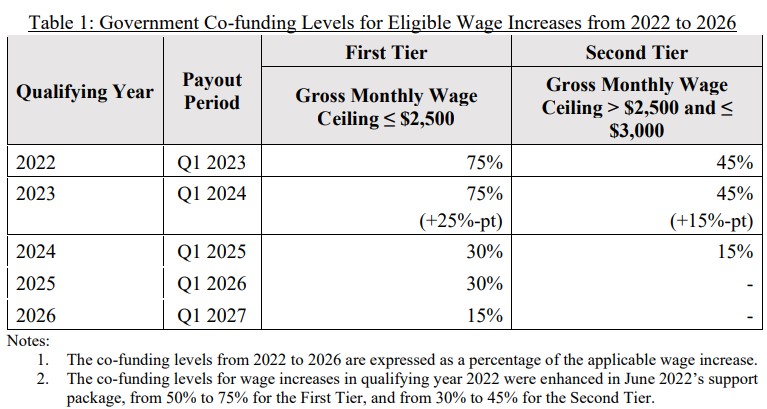
To further strengthen support for employers in uplifting lower-wage employees, the Government will enhance PWCS co-funding support for wage increases in the qualifying year 2023 (see Table 1). The enhanced 2023 co-funding support will also apply to wage increases given in qualifying year 2022 and sustained in 2023. All other scheme parameters remain unchanged.

Senior Employment Credit (SEC)

Under the SEC, the Government provides wage offsets to help employers that employ Singaporean workers aged 55 and above adjust to the higher Retirement Age and Re-employment Age. The SEC will be extended from 2023 to 2025 to continue providing wage offsets, and encourage employers to offer flexible work arrangements and structured career planning.

Details to be announced at MOM’s Committee of Supply (COS) 2023.

Part-time Re-employment Grant

The Part-time Re-employment Grant (PTRG) helped to increase the availability of part-time re-employment to senior workers in participating companies. The Part-time Re-employment Grant will be extended to 2025 to continue providing wage offsets, and encourage employers to offer flexible work arrangements and structured career planning.

Details to be announced at MOM’s Committee of Supply (COS) 2023.

Enabling Employment Credit (EEC)

To encourage more employers to hire persons with disabilities, the EEC will be enhanced to cover a larger proportion of wages and a longer duration for PwDs who have not been working for at least six months.

Details to be announced at MOM’s Committee of Supply (COS) 2023.

Uplifting Employment Credit

The Uplifting Employment Credit is a hiring incentive that encourages firms to employ ex-offenders, so as to support their reintegration into
society.

Details to be announced at MOM’s Committee of Supply (COS) 2023.

CPF Transition Support for Platform Workers

To improve the retirement and housing adequacy of Platform Workers (PWs), in November 2022, the Government accepted the Advisory Committee on Platform Workers’ (“the Committee”) recommendation to align CPF contribution rates by PWs and Platform Companies with the rates of employees and employers respectively (“Aligned CPF Contribution Rates”), over a phase-in period of five years.

PWs from mandatory cohorts as well as PWs who choose to opt in to the Aligned CPF Contribution Rates will see the additional CPF contributions from Platform Companies go towards their total earnings. The alignment will boost their savings in their CPF Ordinary and Special Accounts (CPF-OSA), so that they have more for retirement, and can finance their housing loans using CPF instead of cash. At the same time, the Committee recognised that some of these PWs might experience a reduction in take-home pay as they contribute more to their CPF accounts, and therefore recommended that the Government consider providing support for PWs to ease the impact.

Government Introduces the PW CPF Transition Support Scheme in Budget 2023 

In line with the Committee’s recommendation, the Government will introduce the PW CPF Transition Support (PCTS) to provide support for lower-income PWs during the phase-in period. The PCTS will offset part of the PW’s share of the year-on-year increase in CPFOSA contribution rates from Years 1 to 4. Singaporean PWs earning $2,500 or less per month (including from platform work and other employment sources) will be eligible if they are required to or opt in to make contributions based on the Aligned CPF Contribution Rates. 

More details about the PCTS will be announced at the Ministry of Manpower’s Committee of Supply 2023.

Changes to CPF Contribution Rates

The following Budget 2023 initiatives will help enhance the retirement adequacy of seniors who are preparing for or are already in retirement, and help middle-income Singaporeans to save more for retirement.

(A) Increase in Senior Worker CPF Contribution Rates

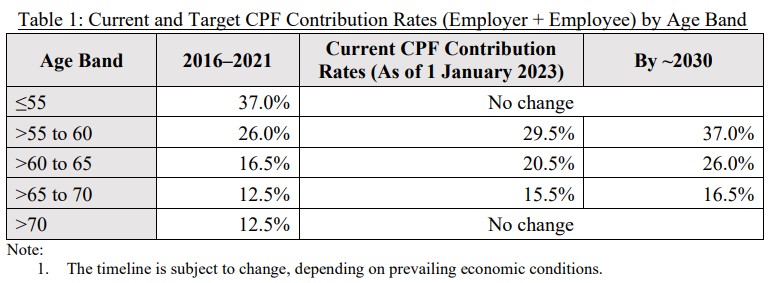
In 2019, the Government announced that CPF contribution rates will be raised gradually over the next decade or so for Singaporean and Permanent Resident workers aged above 55 to 70 (see Table 1). When the increases have been fully implemented, those aged above 55 to 60 will have the same CPF contribution rates as younger workers.

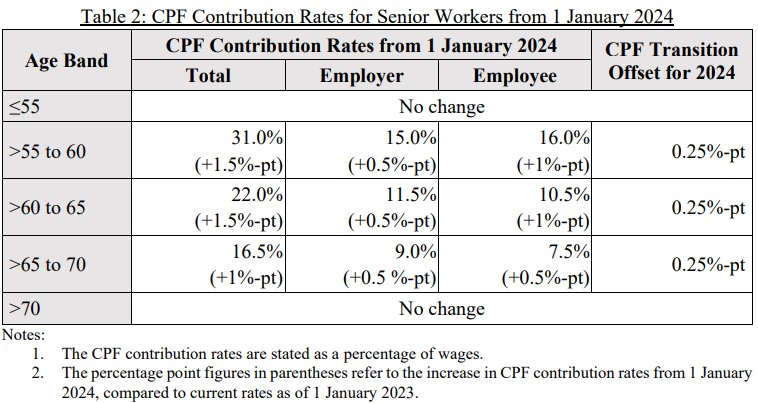
The first two steps of increases took effect on 1 January 2022 and 1 January 2023. The next increase in senior worker CPF contribution rates will take place on 1 January 2024, as shown in Table 2. As with previous increases, this increase will be fully allocated to the Special Account, to help senior workers save more for retirement.

To mitigate the rise in business costs due to this increase, as part of Budget 2023, the Government will provide employers with a one-year CPF Transition Offset equivalent to half of the 2024 increase in employer CPF contribution rates for every Singaporean and Permanent Resident worker they employ aged above 55 to 70 (see Table 2). This will be provided automatically and employers do not need to apply for the offset.

(B) Increase in Minimum CPF Monthly Payouts for Seniors on the RSS

The Government continues to provide targeted support for seniors with less resources to rely on in retirement. The Silver Support Scheme, which covers a third of all seniors aged 65 and above, provides quarterly cash supplements of up to $900 to eligible seniors in addition to their CPF payouts and other forms of Government support, such as the Workfare Income Supplement and ComCare. Many seniors also receive additional retirement support from their loved ones and from their private savings.

Currently, the minimum CPF monthly payout that seniors on the RSS1 can receive is $250. As part of Budget 2023, the Government will raise the minimum CPF monthly payout to $350 from 1 June 2023 for all seniors on the RSS. This will mean higher monthly payouts for seniors who are currently receiving less than $350 per month. Payouts will continue until CPF savings are depleted. These seniors on the RSS can opt to join CPF LIFE any time before turning age 80 to receive lifelong payouts.

(C) Increase in the CPF Monthly Salary Ceiling

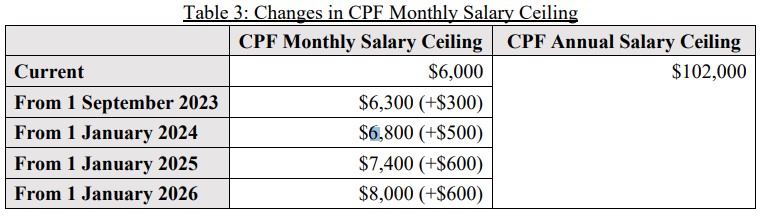
The CPF monthly salary ceiling sets the maximum amount of CPF contributions payable for Ordinary Wages, and is currently set at $6,000. There is also the CPF annual salary ceiling which sets the maximum amount of CPF contributions payable for all wages received in the year, inclusive of both Ordinary Wages and Additional Wages. It is currently set at 17 times of the monthly salary ceiling to account for bonuses equivalent to five months’ salary, and is currently set at $102,000. Both salary ceilings were last updated in 2016.

To keep pace with rising salaries, as part of Budget 2023, the Government will raise the CPF monthly salary ceiling from $6,000 to $8,000 by 2026. The increase will take place in four steps, as shown in Table 3, to allow employers and employees to adjust to the changes.

There will be no change to the CPF annual salary ceiling at this juncture, but it will be reviewed periodically to ensure it continues to cover the broad majority of CPF members.

To ensure that employees earning the same annual salary receive the same CPF contributions regardless of their salary structure, the CPF monthly salary ceiling will eventually be set at one-twelfth of the CPF annual salary ceiling at steady state.

Measures to Encourage Philanthropy and Volunteerism

The following Budget 2023 measures aim to foster a culture of giving in Singapore by encouraging philanthropy and volunteerism.

(A) Extension of the 250% Tax Deduction for Qualifying Donations to Institutions of a Public Character (IPCs) and Eligible Institutions

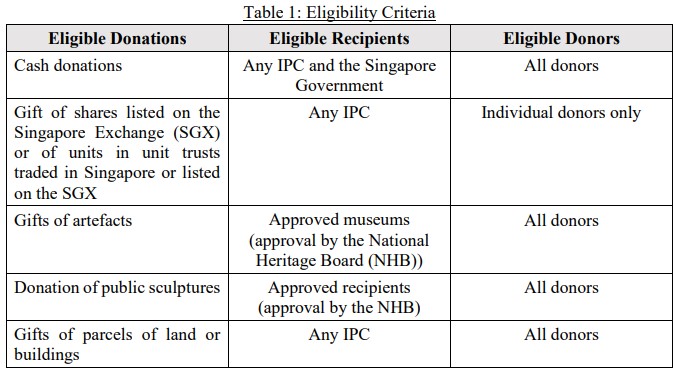
To continue to encourage giving, the Government will extend the 250% tax deduction for qualifying donations made to IPCs and other eligible institutions (see Table 1) for another three years, i.e., for donations made during the period 1 January 2024 to 31 December 2026 (both dates inclusive).

(B) Enhancement of the Corporate Volunteer Scheme.

The Business and IPC Partnership Scheme (BIPS) provides businesses with 250% tax deduction on wages and qualifying expenses when their staff volunteer, provide services, or are seconded to IPCs. The qualifying expenditure is subject to an annual cap of $250,000 per business, and $50,000 per IPC. 

BIPS is due to lapse after 31 Dec 2023. BIPS will be enhanced into a broader Corporate Volunteer Scheme, and extended for three more years to 31 December 2026. In addition, the following enhancements will be made with effect from 1 January 2024. First, the scope of qualifying volunteering activities will be expanded to include activities which are conducted virtually (e.g., online mentoring and tuition support for youths/children) or outside of the IPCs’ premises (e.g., refurbishment of rental flats). Second, the cap on qualifying expenditure per IPC will be doubled from $50,000 to $100,000 per calendar year. All other conditions of the scheme will remain the same.

Global Anti-Base Erosion (GloBE) Rules (i.e., Income Inclusion Rule and Undertaxed Profits Rule) and Domestic Top-up Tax (DTT)

Existing Tax Treatment

In Budget 2022, Minister for Finance announced that in response to the global minimum effective tax rate under the Pillar 2 GloBE rules of the Base Erosion and Profit Shifting (BEPS) 2.0 project, and based on consultation with industry stakeholders, MOF would study the introduction of a top-up tax. If introduced, this would top up the effective tax rate of multinational enterprises operating in Singapore with annual group revenue of at least €750 million, as reflected in the consolidated financial statements of the ultimate parent entity, to 15%.

New Tax Treatment

Singapore plans to implement the GloBE rules and DTT from businesses’ financial year starting on or after 1 January 2025. We will continue to monitor the international developments and adjust our implementation timeline as needed if there are delays internationally.

We will also continue to engage businesses and provide them with sufficient notice ahead of any rules becoming effective.

Enterprise Innovation Scheme (EIS)

Existing Tax Treatment

Currently, the following tax measures are available to
encourage research and development (R&D),
intellectual property (IP) registration, IP rights
acquisition and IP rights licensing:

a) 250% tax deduction for staff costs and consumables incurred on qualifying R&D projects conducted in Singapore under sections 14C and 14D of the Income Tax Act 1947(ITA). Current sunset date is Year of Assessment (YA) 2025. 

b) 200% tax deduction for the first $100,000 (and 100% for amounts exceeding $100,000) of qualifying IP registration costs under section 14A of the ITA. Current sunset date is YA2025. 

c) 100% writing-down allowance (WDA) over a period of five, 10 or 15 years on acquisition cost of qualifying IP rights under section 19B of the ITA. Current sunset date is YA2025. 

d) 200% tax deduction for the first $100,000 (and 100% for amounts exceeding $100,000) of qualifying IP rights licensing expenditure under sections 14 or 14C, and 14U of the ITA. Current sunset date for section 14U is YA2025. In addition, 100% tax deduction can be claimed for training expenditure incurred, subject to the general tax deduction rules under sections 14 and 15 of the ITA.

New Tax Treatment

To encourage businesses to engage in R&D, innovation and capability development activities, the following suite of tax measures will be enhanced or introduced under the EIS:

a) Enhance the tax deduction to 400% for the first $400,000 of staff costs and consumables incurred on qualifying R&D
projects conducted in Singapore for each YA from YA2024 to YA2028.

b) Enhance the tax deduction to 400% for the first $400,000 of qualifying IP registration
costs incurred per YA from YA2024 to YA2028.

c) Enhance the tax allowance/deduction to
400% for the first $400,000 (combined cap) of qualifying expenditure incurred on
the acquisition and licensing of IP rights per YA from YA2024 to YA2028. This enhancement will only be available to businesses that generate less than $500 million in revenue in the relevant YA.

d) Enhance the tax deduction to 400% for the first $400,000 of qualifying training expenditure incurred on qualifying courses
(i.e. courses that are eligible for SkillsFuture Singapore funding and aligned with the Skills Framework) per YA from YA2024 to YA2028.

e) Introduce a 400% tax deduction for up to $50,000 of qualifying innovation expenditure incurred on qualifying innovation projects carried out with polytechnics, the Institute of Technical Education, and other qualified partners per
YA from YA2024 to YA2028.

f) Allow businesses to, in lieu of tax deductions/allowances, opt for a non-taxable cash payout at a cash conversion ratio of 20% on up to $100,000 of total qualifying expenditure across all qualifying activities in (a) to (e) above per YA. The cash payout option will be capped at $20,000 per YA, and will only be available to businesses which have at least three full-time local employees (Singapore Citizens or Permanent Residents with CPF contributions) earning a gross monthly salary of at least $1,400 in employment for six months or more in the basis period of the relevant YA. 
g) The sunset dates for section 14A (Deduction for costs of protecting IP), section 14C (Deduction for qualifying expenditure on R&D), section 14D (Enhanced deduction for qualifying expenditure on R&D), section 14U (Enhanced deduction for expenditure on licensing IP rights) and section 19B (WDA for capital expenditure on acquiring IP rights) of the ITA will be extended till YA2028, in line with the above enhancements.

All other conditions under sections 14A, 14C, 14D, 14U and 19B of the ITA remain the same.

For more information on this scheme, please refer to Annex D-1 IRAS will also provide further details of the changes by 30 June 2023.  

Enhance Double Tax Deduction for Internationalisation (DTDi) Scheme

Existing Tax Treatment

Under the DTDi scheme, businesses are allowed a tax deduction of 200% on qualifying market expansion and
investment development expenses, subject to prior
approval from Enterprise Singapore (EnterpriseSG) or
Singapore Tourism Board (STB).

The DTDi scheme is in place until 31 December 2025.

New Tax Treatment

E-commerce is an increasingly important and relevant mode of overseas expansion for
businesses. To support businesses in their efforts to overcome initial challenges and build up capabilities in internationalising via e-commerce, the scope of the DTDi scheme will be enhanced to include a new qualifying activity “e-commerce campaign” and cover the following e-commerce campaign startup expenses paid to e-commerce platform/service providers:

a) Business advisory: Advisory on market promotion and execution plans (e.g. choice of suitable e-commerce platforms);

b) Account creation: Assistance with setting up accounts on e-commerce platforms, and the right to sell on e-commerce platforms;

c) Content creation: Design of e-commerce campaign publicity materials (e.g. e-store banners, online product images); and 

d) Product listing and placement: Uploading content on products/services to ecommerce platforms, and selection of suitable frequency and timing to display content on products/services. Prior approval is required from EnterpriseSG to enjoy DTDi on the new qualifying activity. For each business, EnterpriseSG will only approve DTDi support for e-commerce campaigns for a maximum period of one year applied on a per country basis. The above enhancement will take effect for qualifying e-commerce campaign startup expenses incurred on or after 15 February 2023. 

EnterpriseSG will provide further details of the changes by 28 February 2023.  

Option to Accelerate the Write-off of the Cost of Acquiring Plant and Machinery (P&M)

Existing Tax Treatment

Businesses that incur capital expenditure on the acquisition of P&M may claim capital allowance (CA) under section 19 (i.e. write-off over the working life of the assets as specified in the Sixth Schedule) or section 19A (i.e. write-off over one or three years) of the ITA.

New Tax Treatment

To provide temporary broad-based support to businesses during this period of restructuring, businesses that incur capital expenditure on the acquisition of P&M in the basis period for YA2024 (i.e. financial year ending in 2023) will have an option to accelerate the write-off of the cost of acquiring such P&M over two years. This option, if exercised, is irrevocable.

The rates of accelerated CA allowed are as follows:

a) 75% of the cost incurred to be written off in the first year (i.e. YA2024); and

b) 25% of the cost incurred to be written-off in the second year (i.e. YA2025). The above option will be in addition to the options
currently available under sections 19 and 19A of
the ITA. No deferment of CA claims is allowed under the
above option. This means that if a business opts for the accelerated write-off option, it needs to claim the capital expenditure incurred for acquiring P&M based on the rates of 75% (in YA2024) and 25% (in YA2025) over the two
consecutive YAs.

Provide Option to Accelerate Deduction for Renovation or Refurbishment (R&R) Expenditure

Existing Tax Treatment

Under section 14N of the ITA, businesses that incur qualifying expenditure on R&R may claim tax deduction on such expenditure over three consecutive YAs on a straight-line basis, starting from the YA relating to the basis period in which the R&R expenditure is incurred. A cap of $300,000 for every relevant period of the three consecutive YAs applies. 

New Tax Treatment

To provide temporary broad-based support to businesses during this period of restructuring, businesses that incur qualifying expenditure on R&R during the basis period for YA2024 (i.e. financial year ending in 2023) will have an option to claim R&R deduction in one YA (i.e. accelerated R&R deduction). The cap of $300,000 for every relevant period of three
consecutive YAs will still apply. This option, if exercised, is irrevocable.

This option will be in addition to the existing option currently available under section 14N of the ITA. 

Extend Investment Allowance (IA) Scheme

Existing Tax Treatment

The IA scheme provides an additional tax allowance for businesses which incur qualifying fixed capital
expenditure on approved projects. This is calculated as a percentage of the amount of capital expenditure incurred, net of grants, on an approved project. 

The IA scheme, which is administered by the Singapore Economic Development Board, Building and Construction Authority, and EnterpriseSG, is scheduled to lapse after 31 December 2023.

New Tax Treatment

To continue encouraging businesses to make capital investments in plant and productive equipment in Singapore, the IA scheme will be extended till 31 December 2028.

Extend IA-100% Scheme for Automation Projects

Existing Tax Treatment

Businesses can enjoy 100% IA support on the amount of approved capital expenditure, net of grants, for automation projects approved by EnterpriseSG.

The IA-100% scheme is scheduled to lapse after 31 March 2023.

New Tax Treatment

To continue to encourage businesses to transform
through automation, the IA-100% scheme will be extended till 31 March 2026, with the same parameters.

Extend Pioneer Certificate Incentive (PC) and Development and Expansion Incentive (DEI)

Existing Tax Treatment

Both the PC and DEI aim to encourage companies to grow capabilities, conduct new or expanded economic activities, and establish their global or regional headquarters in Singapore.

a) Under the PC, recipients are eligible for corporate tax exemption on income from qualifying activities.

b) Under the DEI, recipients are eligible for concessionary tax rates of 5% or 10% on qualifying income.

The PC and DEI are scheduled to lapse after 31 December 2023.

New Tax Treatment

To continue encouraging companies to anchor and grow strategic high value-added manufacturing and services activities in Singapore, the PC and DEI will be extended till 31 December 2028.

Extend the IP Development Incentive (IDI)

Existing Tax Treatment

The IDI aims to support companies that use and
commercialise IP rights arising from R&D in Singapore. Under IDI, recipients are eligible for concessionary tax rates of 5% or 10% on a percentage of qualifying IP income.

The IDI is scheduled to lapse after 31 December 2023.

New Tax Treatment

To continue supporting the use and commercialisation of IP rights arising from R&D activities in Singapore, the IDI will be extended till 31 December 2028.

Extend and Refine Qualifying Debt Securities (QDS) Scheme

Existing Tax Treatment

The QDS scheme offers the following tax concessions on qualifying income from QDS:

a) 10% concessionary tax rate for qualifying companies and bodies of persons in Singapore;
and

b) Tax exemption for qualifying non-residents and qualifying individuals. To qualify as QDS, debt securities must be substantially arranged in Singapore as follows:

a) All debt securities must be substantially arranged by a financial sector incentive (capital
market) company or a financial sector incentive (standard tier) company (collectively referred to as “FSI company”); and

b) For insurance-linked securities (ILS)6 that are unable to meet the condition in (a) above, at least 20% of the ILS issuance costs incurred by the issuer is paid to Singapore businesses.

The QDS scheme is scheduled to lapse after 31 December 2023.

New Tax Treatment

To continue supporting the development of Singapore’s debt market, the QDS scheme will be extended till 31 December 2028.

The scope of qualifying income under the QDS scheme will be streamlined and clarified such that it includes all payments in relation to early redemption of a QDS. To ensure continued relevance, the requirement
that the QDS has to be substantially arranged in Singapore will be rationalised, as follows:

a) For all debt securities that are issued on or after 15 February 2023, they must be substantially arranged in Singapore by a
financial institution holding a specified licence (instead of a FSI company).

b) For ILS that are issued on or after 1 January 2024, if they are unable to meet the condition in (a) above, at least 30% of the ILS issuance costs incurred by the issuer must be paid to Singapore businesses.

All other conditions of the scheme remain the same. The Monetary Authority of Singapore (MAS) will provide further details by 31 May 2023. 

Extend Tax Exemption on Income Derived by Primary Dealers from Trading in Singapore Government Securities(SGS)

Existing Tax Treatment

Tax exemption is granted on income derived by primary
dealers from trading in SGS.

The tax exemption is scheduled to lapse after 31 December 2023.

New Tax Treatment

To continue supporting primary dealers and encourage trading in SGS, the tax exemption on income derived by primary dealers from trading in SGS will be extended till 31 December 2028.

All other conditions of the scheme remain the same.

Extend and Refine Tax Incentive Scheme for Approved Special Purpose Vehicle (ASPV) Engaged in Asset Securitisation Transactions (ASPV scheme) and Introduce a New Sub-scheme to Support Covered Bonds

Existing Tax Treatment

The ASPV scheme grants the following tax concessions to an ASPV engaged in asset securitisation transactions:

a) Tax exemption on income derived by an ASPV from asset securitisation transactions;

b) Goods and Services Tax (GST) recovery on its qualifying business expenses at a fixed rate of 76%; and

c) Withholding tax (WHT) exemption on payments to qualifying non-residents on over-the-counter financial derivatives in connection with an asset securitisation transaction. 

The ASPV scheme is scheduled to lapse after 31 December 2023.

New Tax Treatment

To continue developing the structured debt market, the ASPV scheme will be extended till 31 December 2028.
Instead of a fixed rate of 76%, the GST recovery rate will be the prevailing GST recovery
rate/methodology accorded to licensed full banks under MAS for the specific year in question.

All other tax concessions and conditions of the ASPV scheme remain the same. Further, to support the issuance of covered bonds in Singapore, a new sub-scheme named ASPV (Covered Bonds) will be introduced for the special purpose vehicle holding the “cover pool” in relation to the covered bonds as defined in MAS Notice 648. 

The ASPV (Covered Bonds) scheme will take effect from 15 February 2023 to 31 December 2028 and will be administered by MAS. 

MAS will provide further details by 31 May 2023. 

Extend and Refine the Financial Sector Incentive (FSI) Scheme

Existing Tax Treatment

The FSI scheme accords concessionary tax rates of 5%, 10%, 12% and 13.5% on income from qualifying banking and financial activities, headquarters and corporate services, fund managing and investment advisory services.

The FSI scheme is scheduled to lapse after 31 December 2023.

New Tax Treatment

To continue supporting the growth of financial sector activities in Singapore, the FSI scheme will be extended and refined as follows:

a) The FSI scheme will be extended till 31 December 2028.

b) The existing concessionary tax rates will be streamlined to two tiers of 10% and 13.5% for new and renewal awards approved on or after 1 January 2024, as follows:

i) FSI-Capital Market, FSIDerivatives Market and FSICredit Facilities Syndication – from 5% to 10%;

ii) FSI-Fund Management and FSIHeadquarter Services – remain at 10%;

iii) FSI-Trustee Companies – from 12% to 13.5%; and

iv) FSI-Standard Tier – remain at 13.5%.

c) The qualifying activities will be updated to ensure continued relevance.

MAS will provide further details of the changes by 31 May 2023.

Extend Insurance Business Development – Insurance Broking Business (IBD-IBB) Scheme

Existing Tax Treatment

The IBD-IBB scheme grants approved insurance and
reinsurance brokers a concessionary tax rate of 10% on commission and fee income derived from insurance
broking and advisory services.

The IBD-IBB scheme is scheduled to lapse after 31 December 2023.

New Tax Treatment

To further strengthen Singapore’s position as a leading insurance and reinsurance centre, the IBD-IBB scheme will be extended till 31 December 2028.

All other conditions of the scheme remain the same.

Extend Tax Concession for Deduction of General Provisions for Doubtful Debts and Regulatory Loss Allowances Made in Respect of Non-credit impaired Financial Instruments for Banks (Including Merchant Banks) and Qualifying Finance Companies

Existing Tax Treatment

Under section 14G of the ITA, banks, merchant banks
and qualifying finance companies can claim a tax deduction for general provisions on non-credit impaired loans and debt securities made under the Financial Reporting Standard 109 or Singapore Financial Reporting Standard (International) 9, and any additional loss allowances as required under prevailing
MAS Notices, subject to a cap. The tax deduction under section 14G is scheduled to lapse after YA2024 (for banks, merchant banks and qualifying finance companies with a 31-December financial year end (FYE)) or YA2025 (for banks, merchant banks and qualifying finance companies with a non-31-December FYE).

New Tax Treatment

To continue to promote the overall robustness and stability of the Singapore financial system, the tax deduction under section 14G of the ITA will be extended till YA2029 (for banks, merchant banks, and qualifying finance companies with a 31-December FYE) or YA2030 (for banks, merchant banks, and qualifying finance companies with a non-31-December FYE).

Extend Three Tax Measures Relating to Submarine Cable Systems

Existing Tax Treatment

Currently, there are three tax measures relating to submarine cable systems:

a) WHT exemption on payments made to non-residents for use of international telecommunications submarine cable capacity under indefeasible right to use (IRU) agreements. This is scheduled to lapse after 31 December 2023. 

b) WDA for the acquisition of an IRU over their useful life. This is scheduled to lapse after 31 December 2025. 

c) IA for the construction and operation of submarine cable systems in Singapore. 

This is scheduled to lapse after 31 December 2023.  

New Tax Treatment

To maintain and enhance Singapore’s international connectivity, all three tax measures will be extended till 31 December 2028, with the same parameters.

Withdraw Tax Deduction for Expenditure Incurred on Building Modifications for Benefit of Disabled Employees

Existing Tax Treatment

Under section 14F of the ITA, employers can claim tax deductions for approved expenditure incurred on any addition or alteration to business premises for the purpose of facilitating the mobility or work of any disabled employee, subject to a one-off cap of $100,000.

New Tax Treatment

The scheme will be withdrawn from 15 February 2023. 

Introduced in Budget 1989, the scheme has become less relevant over the years. Since then, other support schemes (e.g. the Open Door Programme Job Redesign Grant) have been introduced to help employers recruit and retain disabled employees, or to support employers for accommodations beyond (and including) physical modifications of the workplace. Section 14N on tax deductions for Renovation and Refurbishment, introduced in Budget 2008, can also be tapped upon for workplace modifications without the need for prior approval from government agencies.

Buyer's Stamp Duty and Additional Conveyance Duties for Buyers

Existing Tax Treatment

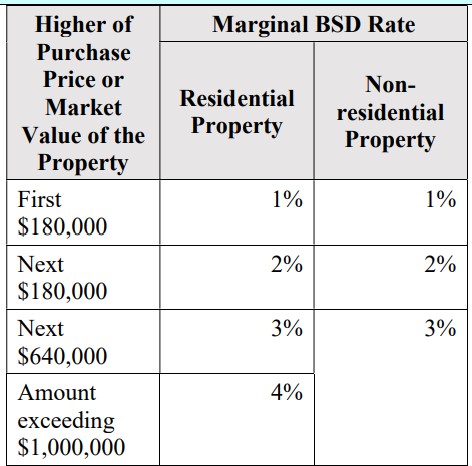
Currently, transactions in residential and non-residential properties are subject to marginal BSD rates of 1% to 4% and 1% to 3% respectively:

New Tax Treatment

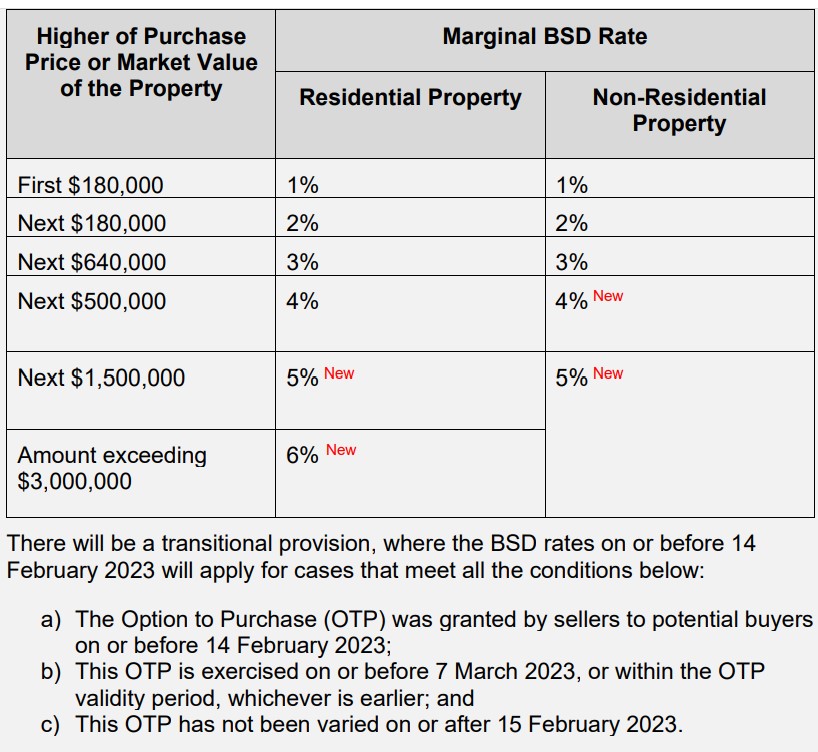
To enhance the progressivity of our BSD regime, higher marginal BSD rates will be introduced for higher-value residential and non-residential properties.

For residential properties, a new marginal BSD rate of:

a) 5% will apply to the portion of the property value in excess of $1.5 million and up to $3 million; 

and

b) 6% will apply to the portion of the property
value in excess of $3 million.

For non-residential properties, a new marginal BSD rate of:

a) 4% will apply to the portion of the property value in excess of $1 million and up to $1.5
million; 

and

b) 5% will apply to the portion of the property value in excess of $1.5 million.

The revised rates will apply to all properties acquired on or after 15 February 2023.

Tobacco Excise Duty

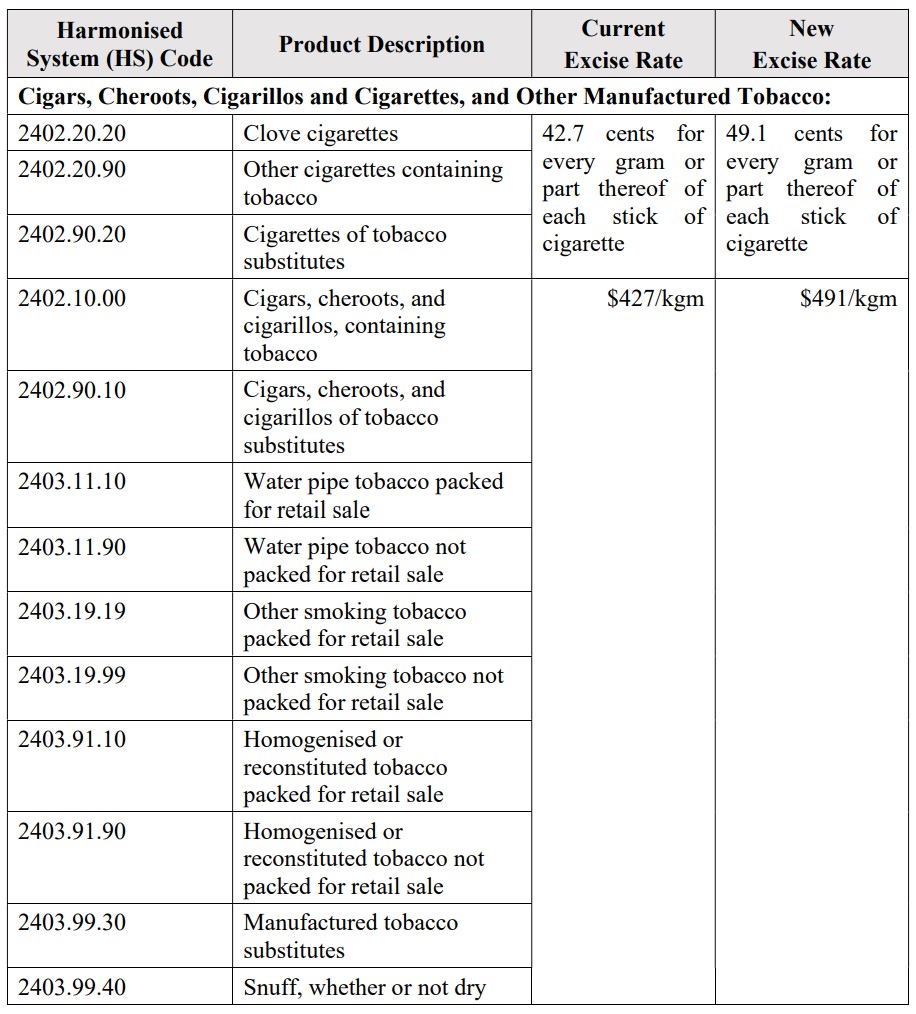
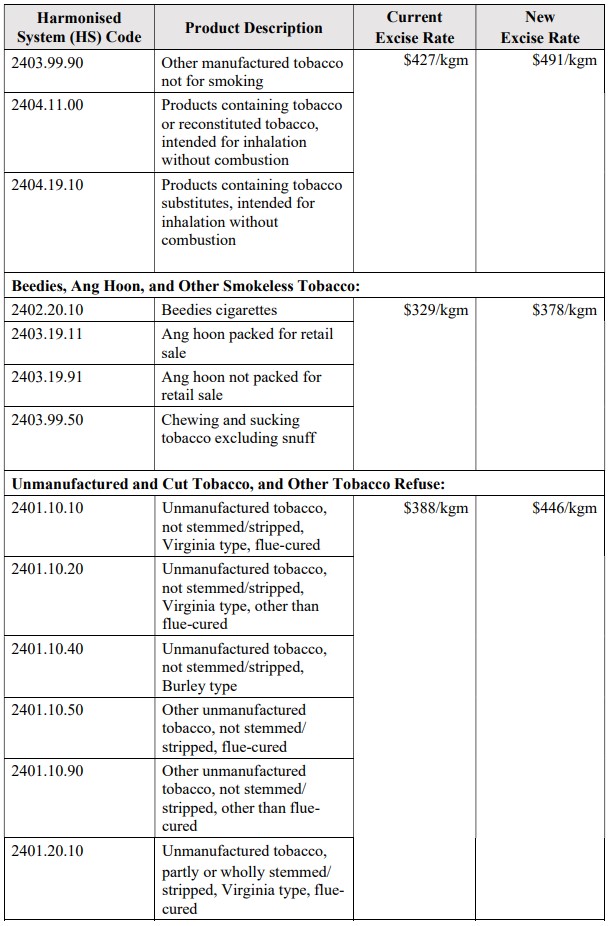
To discourage the consumption of tobacco products, we will raise the excise duties by 15% across all tobacco products. These tax changes will take effect on and after 14 February 2023:

(A) Cigars, Cheroots, Cigarillos and Cigarettes, and Other Manufactured Tobacco:

From $427/kgm or 42.7 cents/stick of cigarette to $491/kgm or 49.1 cents/stick of cigarette.

(B) Beedies, Ang Hoon, and Other Smokeless Tobacco: 

From $329/kgm to $378/kgm.

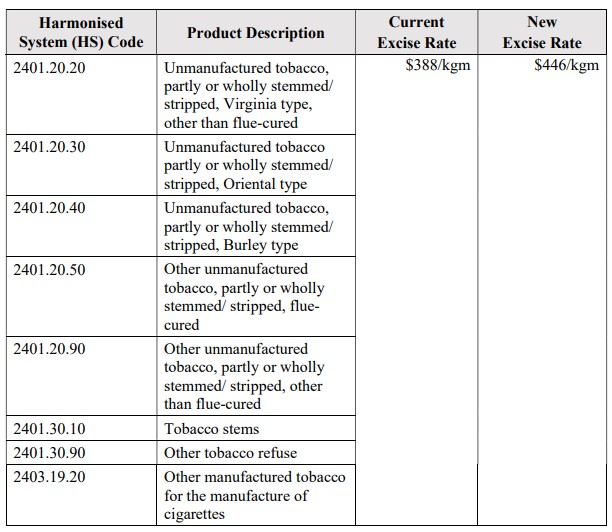
(C) Unmanufactured and Cut Tobacco and Other Tobacco Refuse: From $388/kgm to $446/kgm.

Vehicular Tax Changes

(A) Additional Registration Fee Changes

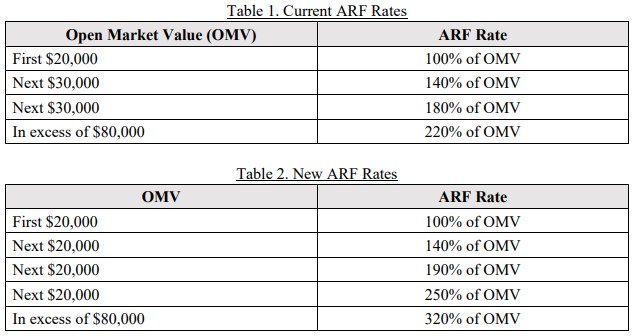
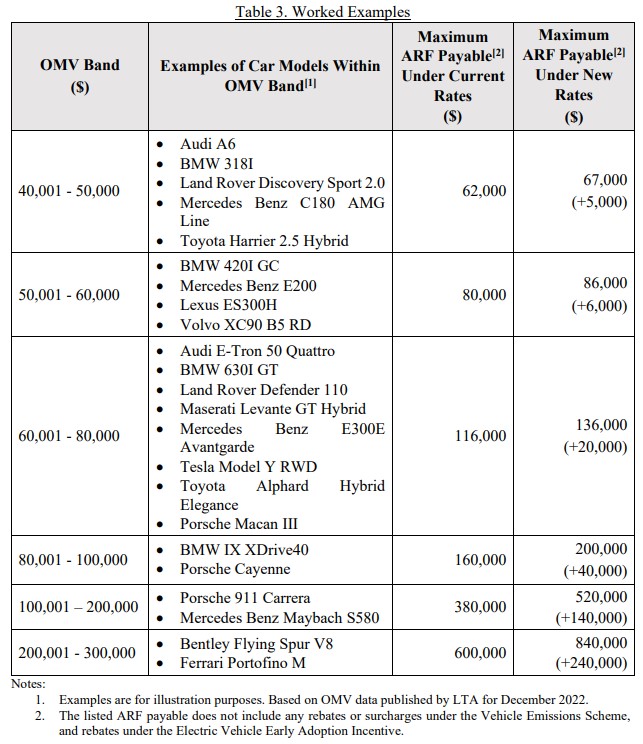
To make our vehicular tax structure more progressive, the following changes will be made to the Additional Registration Fee (ARF) payable for cars, taxis, and goods-cum-passenger vehicles (GPVs):

The new ARF structure will apply to all new and imported used cars and GPVs registered with Certificate of Entitlements (COEs) obtained from the second bidding exercise in February 2023 onwards. The second COE bidding exercise in February 2023 will take place from 20 to 22 February 2023. 

For cars that do not need to bid for COEs (e.g. taxis, classic cars), the new ARF structure will apply for those registered on or after 15 February 2023.

(B) Preferential Additional Registration Fee Rebate Changes

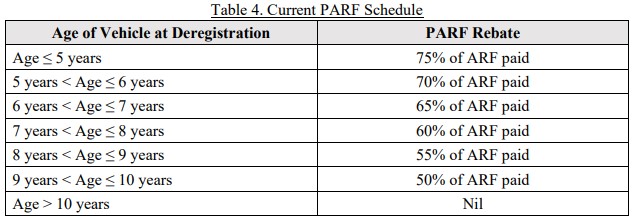
To make our vehicular tax system more progressive, PARF rebates will be capped at $60,000. For example, a vehicle with an OMV of $90,000 paying an ARF of $168,000 under the new rates would receive $60,000 in PARF rebates, instead of $84,000, if it is deregistered when it is nine years old.

For cars that need to bid for COEs, the PARF cap will apply to those that are registered with COEs obtained from the second bidding exercise in February 2023 onwards and are subsequently
deregistered within their PARF eligibility period.

For cars that do not need to bid for COEs (e.g. taxis), the PARF cap will apply to those that are registered on or after 15 February 2023 and are subsequently deregistered within the PARF eligibility period.

The PARF cap does not apply to vehicles that are not eligible for PARF rebates, such as GPVs, classic cars, and vehicles that have been laid-up.

Extent of Penalty for Non-Compliance and the Importance of Accounting Records

The former Chief Executive Officer of Hyflux Ltd (Hyflux), Ms Lum Ooi Lin, its former Chief Financial Officer, Mr Cho Wee Peng, and four independent directors of Hyflux at the material time were charged in court on 17 November 2022 for disclosure-related offences under the Securities and Futures Act (SFA). Ms Lum was further charged with an offence under the Companies Act (CA) for her failure in ensuring Hyflux’s compliance with accounting standards.

Against Lum Ooi Lin:

(a) One count of section 203(2) read with section 331(1) SFA, for consenting to Hyflux’s intentional failure to disclose information relating to the Tuaspring Integrated Water and Power Project (Tuaspring), when such disclosure was required under the Singapore Exchange Listing Rules (Listing Rules);

(b) One count of section 253(1)(b) read with sections 253(4)(b)(i) and 277(3) SFA for Hyflux’s omission to state the same information relating to Tuaspring in the 2011 Offer Information Statement (2011 OIS). The 2011OIS was issued for the offer of S$200 million, 6% preference shares on 13 April 2011; and

(c) One count of section 201(5) read with section 204(1) CA for failing to ensure that Hyflux made disclosures required under the accounting standards for its financial statements for the financial year ended 31 December 2017. This included the failure to disclose the breach of a subsidiary’s loan agreement that permitted its lenders to demand accelerated repayment.

Against Cho Wee Peng:

(a) One count of section 203(2) read with section 331(1) SFA for conniving in Hyflux’s intentional failure to disclose information relating to Tuaspring, when such disclosure was required under the Listing Rules.

Against four Independent Directors of Hyflux, namely Teo Kiang Kok, Gay Chee Chong, Murugasu Christopher and Rajskar Kuppuswami Mitta:

(a) One count each of section 203(2) read with section 331(1) SFA, for their neglect in connection with Hyflux’s intentional failure to disclose information relating to Tuaspring, when such disclosure was required under the Listing Rules; and

(b) One count each of section 253(1)(b) read with sections 253(4)(b)(i) and 277(3) SFA, for Hyflux’s omission to state the same information in the 2011 OIS.

In accordance with Section 199 of the Companies Act 1967, every company must cause to be kept such accounting and other records as will sufficiently explain the transactions and financial position of the company and enable true and fair financial statements and any documents required to be attached thereto to be prepared from time to time, and must cause those records to be kept in such manner as to enable them to be conveniently and properly audited.

If the default is made in complying with this section, the company and every officer of the company who is in default shall be guilty of an offence and shall be liable on conviction to a fine not exceeding $5,000 or to imprisonment for a term not exceeding 12 months and also to a default penalty.

FAQ – GST change 2023

The amount relating to the option money paid before 1 Jan 2023 is subject to the GST rate of 7%.

The remaining payment will be subject to the GST rate of 8% as the property is only made available on/ after 1 Jan 2023.

If you receive full payment for the banquet before 1 Jan 2023, you should only charge 7% GST to your customer even if the banquet is to be held on/ after 1 Jan 2023.

If you only receive a deposit before 1 Jan 2023 and will receive the balance on/ after 1 Jan 2023, the deposit is subject to 7% GST while the remaining payment is subject to 8% GST.

You should also make clear to your customer that the portion of the banquet price paid before 1 Jan 2023 is inclusive of 7% GST while the balance to be paid on/ after 1 Jan 2023 is inclusive of 8% GST.

The letter of claim is not a bill for payment (i.e. invoice) for GST purposes.

On the understanding that you would only issue the invoice to the developer upon the certification of the work done in 2023 and collect payment from the developer thereafter, the time of supply would be on/ after 1 Jan 2023. Hence, the supply of your construction services would be subject to 8% GST.

However, you can choose to charge GST at 7% as you have completed the construction works before 1 Jan 2023.

As you would only issue the invoice and collect the retention sum from the developer in Nov 2023, the time of supply would be on/ after 1 Jan 2023. Hence, the retention sum would be subject to 8% GST.

However, you can choose to charge GST at 7% on the retention sum as you have completed the construction works before 1 Jan 2023.

You are not allowed to reflect GST at 8% before the rate change effective date of 1 Jan 2023.

The advance invoice pertaining to the services from 1 Oct 2022 to 31 Mar 2023 should reflect GST at 7%.

If you do not receive full payment before 1 Jan 2023, you are required to issue a credit note for the lower of remaining payment or the remaining value of service to be performed on/ after 1 Jan 2023. Thereafter, you are required to issue a new tax invoice in respect of the amount credited out to charge GST at 8%.

Alternatively, you may issue a credit note to cancel out the original invoice and at the same time, reissue new tax invoice(s) for the value of supply subject to GST at 7% and value of supply subject to GST at 8% .

No. You are not allowed to issue a tax invoice with GST at 8% before the rate change effective date.

If you issue a tax invoice before 1 Jan 2023, you should reflect 7% GST on the tax invoice. If the payment is not received before 1 Jan 2023, you will need to issue credit note to cancel the original tax invoice and to issue a new tax invoice for the goods delivered after the rate change, showing 8% as the GST rate.

When you issue the tax invoice to your customer before 1 Jan 2023, you are advised to inform your customer on the potential GST adjustment under the rate change transitional rules to avoid dispute on the GST rate and GST amount payable on the supply.

You are not allowed to reflect GST at 8% before the rate change effective date of 1 Jan 2023. Hence, your invoice that is issued in Dec 2022 should reflect GST of 7% on the rental for the period 5 Dec 2022 to 4 Jan 2023.

Subsequently, assuming payment has not been received before 1 Jan 2023, you should issue a credit note by 15 Jan 2023 to cancel the portion of the rental for the period 1 Jan 2023 to 4 Jan 2023 billed at 7%, and to issue a new tax invoice at 8% for the same period.
The rental can be apportioned based on the number of days as follows:

Portion of rental that is subject to the GST of 7%
= Monthly rental x 27/ 31 days
Portion of rental that is subject to the GST of 8%
= Monthly rental x 4/ 31 days

When you issue the tax invoice to your customer before 1 Jan 2023, you are advised to inform your customers on the potential GST adjustment under the rate change transitional rules to avoid dispute on the GST rate and GST amount payable on the supply.

If you provide rebates to your customer that represent a discount for a past sale, you should calculate the GST on the rebate using the rate that is originally charged on the sale.

On the other hand, if the rebate is used to offset against the value of your next sale to your customer which takes place on or after 1 Jan 2023, you should charge GST at 8% on the net value of the sale.

For returned goods, you should adjust the GST using the rate that is originally charged on your supply of goods and maintain documentary evidence to show whether the goods returned were supplied before or on/after 1 Jan 2023.

Source: IRAS – FAQ